

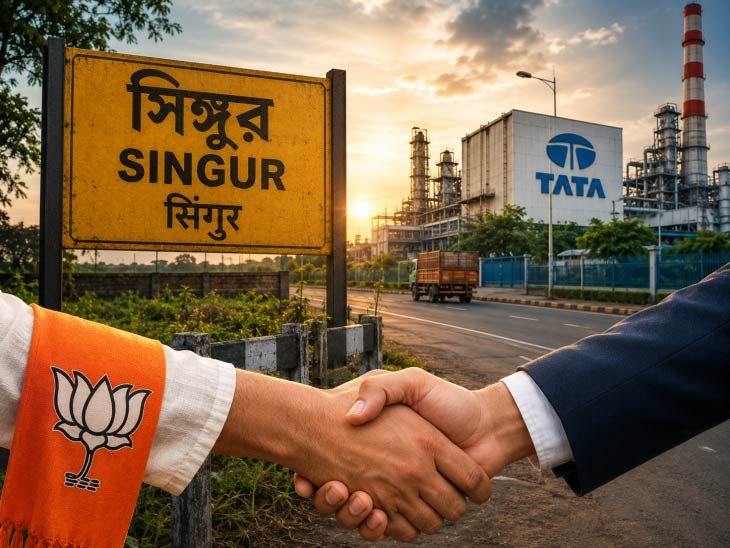

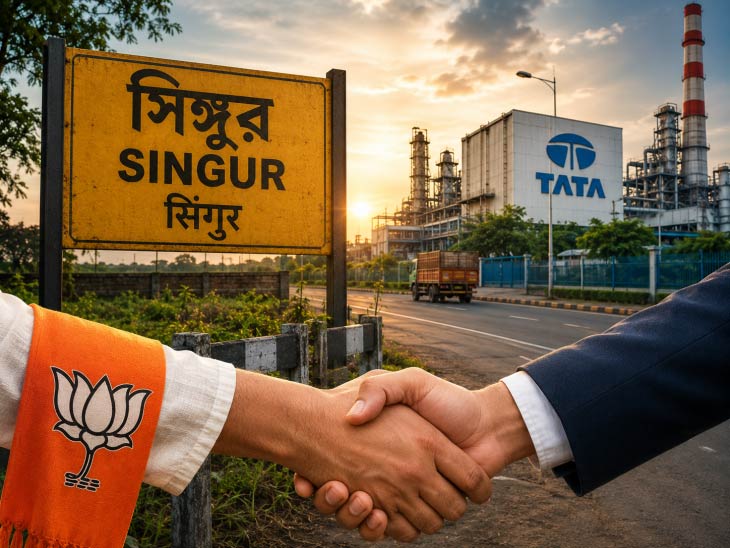
Singur, the town that marked the beginning of the end of the Left Front’s 34-year rule in West Bengal nearly two decades ago, is back in the spotlight. With the BJP set to form the government in the state, preparations have reportedly begun for the possible return of the Tata Group to Singur.
Speaking to Dainik Bhaskar, State Commerce and Industries Minister Tapas Roy said discussions with the Tata Group are underway. Talks are being held with different Tata companies, and if the group agrees to return to Singur, the government will not allot the land to any other company.
He added that Chief Minister Suvendu Adhikari is personally monitoring the matter. Since the discussions are still at an early stage, no official announcement has been made.
However, Singur has changed dramatically since Tata’s Nano project was shelved in 2008. The 997 acres of land across five villages, where the Nano factory was planned in 2006, is now largely covered with bushes.
Once among the most fertile agricultural land in West Bengal, it produced paddy, potatoes and several other crops. Farmers say the Trinamool Congress-led agitation brought everything to a halt. Much of the land has turned barren, and many farming families have moved away.
Dainik Bhaskar visited the five villages—Bajemelia, Beraberi, Khaserbheri, Gopalnagar and Singherbheri—and spoke to local farmers. Most said Tata’s exit in 2008 caused huge losses.
They believe that if the Nano project had gone ahead, their children would have found employment locally instead of moving elsewhere. In recent days, government officials have also visited the area, inspecting the land and taking photographs.
At the same time, a section of villagers who opposed the project in 2006 remain firm in their stand. They say they will not allow the land to be acquired again.
Prabir Patra, a key member of the Singur Krishi Raksha Committee, said they were never against industrialisation but wanted to protect fertile three-crop agricultural land. He said they continue to hold the same position today.
Many stories remain in Singur… 3,600 families still live with the loss, but are ready to give land again
Many of the families who gave up their land for the Nano project were left devastated after Tata withdrew from Singur. Around 3,600 such families currently receive ₹2,000 a month and 16 kg of rice from the government. Even today, several of them say they have not recovered from the emotional and financial setback.
Seventy-five-year-old Angur Das said her family had given six bighas of land for the project. After Tata left, her husband fell seriously ill due to the shock and died in 2019. She said that if Tata returns, she is willing to give whatever land she still owns.
Anidya Das, who was 12 years old during the protests and is now 32, said that if the factory had been built, he would not have had to travel to Kolkata every day for a job paying ₹8,000–10,000 a month. His father had also given land, but today it is no longer suitable for farming.
Swarup Das of Khaserbheri gave two bighas of land for the project. He recalled that after receiving the compensation cheque, he moved to Dubai. His brothers, Devarup and Arup Das, had been selected by Tata for mechanical engineering training in Uttarakhand.
They had bank accounts opened and were receiving excellent facilities during training. However, all those opportunities disappeared when the project was cancelled. Swarup says his biggest regret is that they lost both the factory and productive farmland.
If Tata or any other major industry returns, he is prepared to give his land again.
Even so, Tata’s return may not be easy
Dr Udayan Das, president of the Singur Shilpa Vikas Committee, which supported land acquisition for the project, believes Tata’s return will be difficult. He said land prices have increased nearly 15 times since 2006.
Roadside land that was worth around ₹3 lakh per bigha is now valued at nearly ₹1 crore per bigha. In interior areas, prices have risen from about ₹10,000 to around ₹1.5 lakh. According to him, if Tata decides to return, compensation alone could cost more than ₹1,300 crore, making the project financially challenging.




