


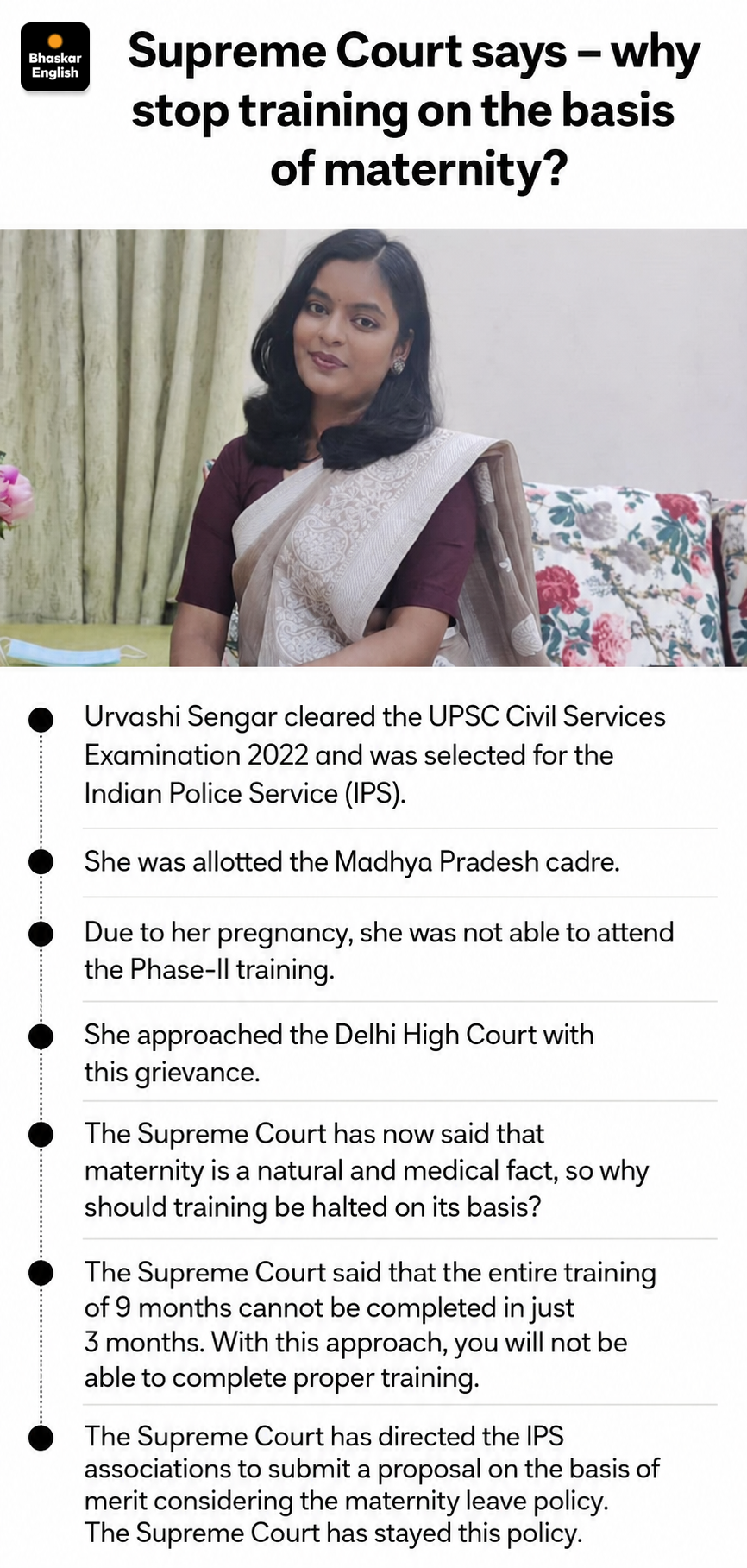
Madhya Pradesh cadre 2023 batch IPS officer Urvashi Sengar has filed a petition in the Supreme Court after not being granted permission for her training following pregnancy.
Actually, Urvashi became pregnant during the probation period. According to the current rules of IPS training, in such a situation, one has to leave training with their original batch and join another batch after the child’s birth. Pregnant officers are also exempted from physically demanding activities such as horse riding, long-distance running, and combat training.
Current rules of IPS training for pregnant women in India
- If a woman officer becomes pregnant during training, her service cannot be terminated solely on this ground.
- Eligible women officers are granted maternity leave under the All India Services Leave Rules.
- If a medical practitioner advises that running, obstacle courses, weapons training, or other strenuous activities are not safe for pregnancy, they may be postponed or modified. This decision is taken in accordance with the Medical Board and training academy’s instructions.
- If any part of training is missed due to maternity leave, the officer is given an opportunity to complete the remaining training later. The training period may also be extended if necessary.
- Decisions related to training are taken based on medical advice, keeping in mind the safety of the female officer and the unborn child.
What did the Supreme Court ask?
During the hearing of the case, the Supreme Court questioned the rationale behind the existing rules. The bench asked the Centre why a female officer who has been declared medically fit after delivery and is willing to undergo training should be prevented from completing her probation period.
The court also questioned whether maternity should become an obstacle in an officer’s career progression, especially when there is no medical problem hindering the resumption of training.
Court adjourned the hearing
The Supreme Court refused to order the inclusion of Urvashi Sengar in the currently ongoing training. The court said that 3 weeks of training out of 9 weeks have already been completed. This makes it clear that you will not be able to train properly. However, the court took on record the central government’s statement that this will not affect the seniority of the woman IPS officer.
Along with this, the Supreme Court has directed that the Central Administrative Tribunal (CAT) should hear the woman IPS officer’s original petition on merit basis.

Why challenge the old rule of 1993?
The petition filed in the Supreme Court states that in today’s times, such decisions should be based on modern medical science and individual medical fitness rather than old rules.
This 1993 rule applies equally to all pregnant officers without any discrimination and makes no distinction between Phase-1 and Phase-2 training.
Phase-2 mainly consists of classroom-based studies, academic modules and institutional training, which is not physically very demanding. Therefore, exclusion solely on the basis of pregnancy is not appropriate.
In 2004, the Department of Personnel and Training (DoPT) amended this old rule for women IAS officers, under which women IAS probationers are now allowed to complete training based on medical fitness. In such a case, keeping the old 1993 rule applicable for IPS officers is against the principle of equality.