
The Supreme Court on Tuesday refused to grant an interim stay on the Central Board of Secondary Education’s (CBSE) three-language policy, which is set to be implemented from the 2026-27 academic session.
The court, however, agreed to hear a batch of petitions challenging the policy in detail next week.
A bench comprising Chief Justice of India Surya Kant, Justice Joymalya Bagchi and Justice V. Mohan was hearing petitions filed by students, parents and teachers against the CBSE circular issued on May 15.
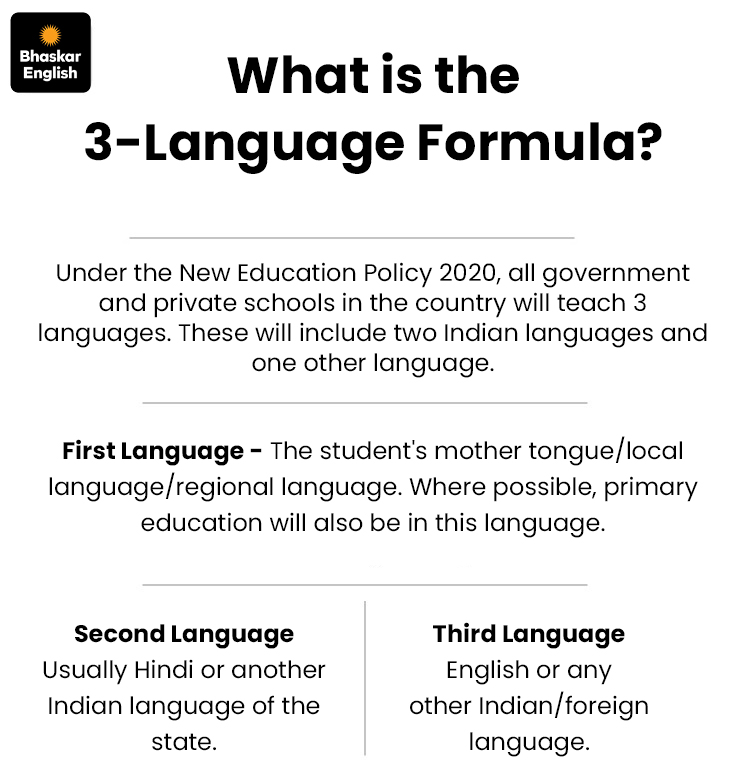
The petitioners argued that, under the new policy, students would be required to study two Indian languages, forcing them to discontinue the language they had been learning since Class 5.
The plea also described English as a “non-native” language and raised concerns over the availability of qualified teachers and textbooks for Indian languages.
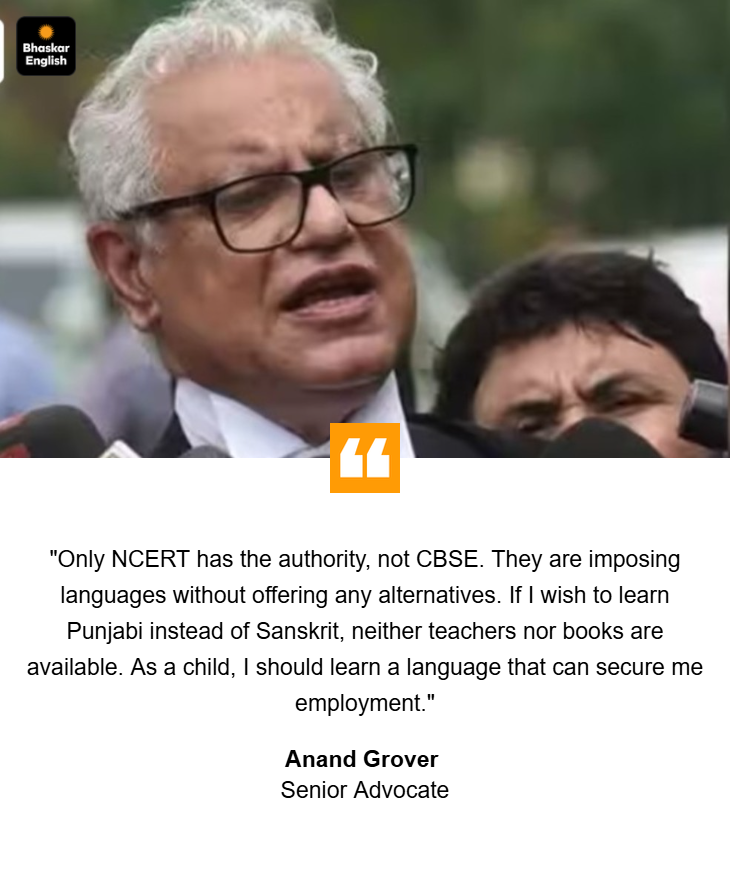
Schools lack teachers and books, say petitioners
Senior advocate Mukul Rohatgi highlighted practical difficulties in implementing the policy.
He cited the example of a Class 9 student who had been studying French and would now be required to switch to another Indian language before examinations.
“Which school in Delhi has teachers to teach Tamil or several other Indian languages?” Rohatgi asked, arguing that schools are unprepared for such a transition.
Senior advocate Gopal Sankaranarayanan sought an interim stay on the policy, contending that schools neither have sufficient teachers nor textbooks.
He informed the court that only three language textbooks were currently available on the NCERT website.
He also argued that the sudden policy shift could lead to job losses for teachers of foreign languages.
Responding to the concern, the Chief Justice remarked that learning additional languages is beneficial and observed that if teachers lose their jobs, “they can be hired back.”
Centre asked to file reply within 10 days
Appearing for the Centre, Additional Solicitor General Aishwarya Bhati sought two weeks to file the government’s response. The court, however, directed the Centre to submit its reply within 10 days.
The bench also heard submissions from advocates Rahul Shyam Bhandari and G. Priyadarshini, appearing for former Maharashtra minister Fauzia Khan, who has intervened in the matter.
The intervenors argued that the policy could adversely affect students’ mental health, particularly those from economically weaker sections.
How the policy will apply
Under the CBSE’s implementation plan, the policy will be introduced in phases:
Current Class 10 (2026-27): No change. Students will continue appearing for board examinations in two languages.
Current Class 9: Students must study three languages, including two Indian languages. However, the third language will not be part of the Class 10 board examination and will instead be assessed by schools.
Current Classes 7 and 8: The same arrangement will apply, with the third language evaluated internally.
Current Class 6: This will be the first batch to fully follow the policy. These students will study three languages from Class 6 onwards and will appear for a board examination in the third language when they reach Class 10.
Exemptions under the policy
The CBSE has exempted certain categories of students from the mandatory third-language requirement.
Students with disabilities will be exempt as provided under law. Similarly, CBSE schools located abroad and students returning to India from overseas will not be required to study an Indian language as the third language.
Students whose parents are transferred to another state will also be allowed to continue studying the languages they had already opted for.
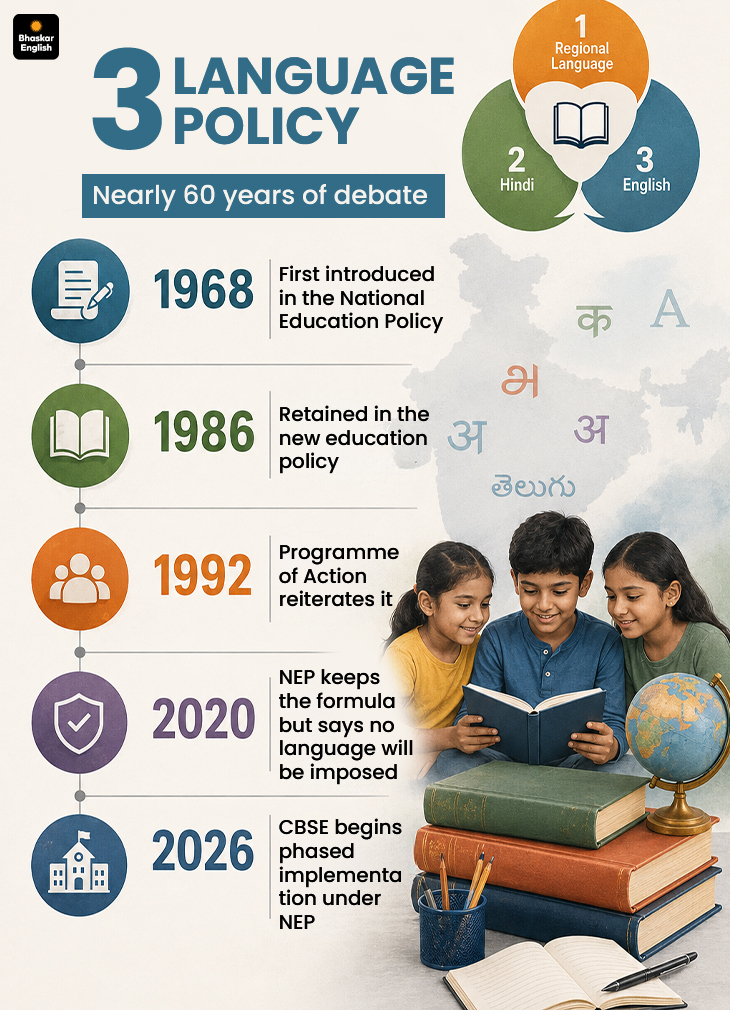
NEP 2020 was introduced after 34 years
The CBSE issued the circular implementing the three-language policy on May 15 for the 2026-27 academic session.
The decision was challenged in the Supreme Court by a group of 19 students, parents and teachers, who argued that it contradicted the board’s earlier clarification issued on April 9, which had stated that the revised third-language rule would not apply to Class 9 students until the 2029-30 academic session.
The three-language policy forms part of the National Education Policy (NEP) 2020, approved by the Union government on July 29, 2020.
It marked the first major overhaul of India’s education policy in 34 years, replacing the policy introduced in 1986 and revised in 1992.
The Centre aims to implement NEP 2020 across the country by 2030. However, as education falls under the Concurrent List of the Constitution, states are not legally bound to adopt every provision, leaving room for variations in implementation.