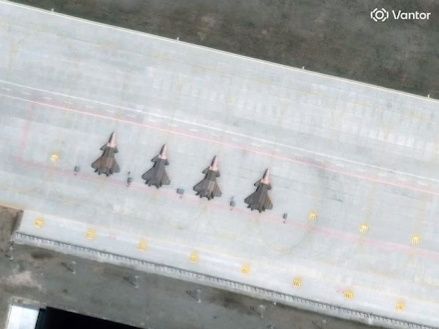

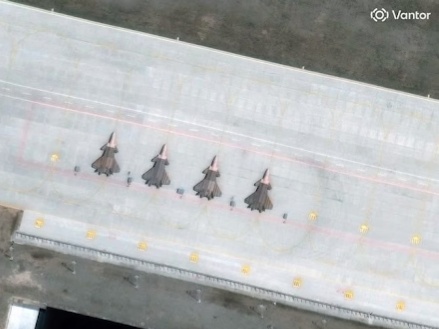
Commercial satellite imagery has reportedly revealed that China has deployed its most advanced J-20 stealth fighter jets at two airbases close to the India-China Line of Actual Control (LAC).
According to the images, a total of 12 J-20 aircraft were spotted at Hotan Airbase in Xinjiang and Damxung Airbase in Tibet, marking what is believed to be one of the largest such deployments near the LAC in recent years.
What the satellite images show
According to the report, satellite imagery from commercial firm Vantor showed eight J-20 “Mighty Dragon” stealth fighter jets at Hotan Airbase in Xinjiang on 9 July. Separate images captured on 25 June showed four J-20 aircraft parked beneath hardened shelters at Damxung Airbase in Tibet.
Taken together, the images indicate that 12 J-20 stealth fighters were stationed at the two airbases within a period of around two weeks.
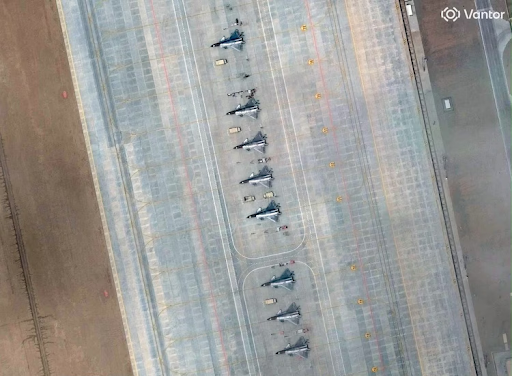
A total of 12 J-20 stealth fighter jets were seen in satellite images at two Chinese airbases near the India-China border within approximately two weeks.
How close are the airbases to India?
Hotan Airbase is located around 245 km from the Indian Air Force’s Daulat Beg Oldi airstrip and approximately 389 km from Leh. Situated in China’s Xinjiang Uyghur Autonomous Region, it serves both civilian and military purposes and is regarded as one of the People’s Liberation Army Air Force’s (PLAAF) key forward operating bases near the India-China border.
The base has a runway measuring about 3,700 metres, capable of supporting large military aircraft. It also features hardened aircraft shelters, expanded aprons and upgraded operational support infrastructure.
In addition to J-20 stealth fighters, the base is believed to host KJ-500 Airborne Early Warning and Control (AEW&C) aircraft, interceptor fighters, CH-4 surveillance and strike drones, and, during military exercises and periods of heightened tension, H-6 strategic bombers.
Damxung Airbase, located in Tibet’s Lhasa Prefecture, lies around 344 km north-west of Tawang in Arunachal Pradesh. It is considered a strategically important PLAAF base overlooking the eastern sector of the LAC.
Located on the Tibetan Plateau, the high-altitude airbase serves as a forward staging base for fighter deployments, operational training and high-altitude missions. Pilots are trained there to operate in demanding terrain and weather conditions.
The base has a major runway capable of supporting regular fighter and military aircraft operations. It also plays an important role in China’s Western Theater Command by enhancing aerial surveillance, rapid military response capabilities and operations directed towards Arunachal Pradesh.
Why the deployment matters
According to the report, defence sources believe the continued presence of J-20 aircraft at these high-altitude airbases suggests that China is integrating such deployments into its routine military posture rather than using them solely for temporary exercises.
The J-20 is China’s fifth-generation stealth fighter, designed for low radar visibility and advanced air combat operations. It is widely regarded as one of the Chinese Air Force’s most capable combat aircraft.
Military activity continues along the border
The reported deployment comes as military tensions remain unresolved along the 3,488-kilometre disputed India-China border. Since the 2020 Galwan Valley clash, both countries have held several rounds of military and diplomatic talks, leading to disengagement in some areas.
However, both sides continue to maintain significant troop deployments, armoured vehicles and advanced air assets along the LAC.
Indian Air Force faces capability gap
The report also noted that the Indian Air Force continues to face a shortage of fighter aircraft. Deliveries under the indigenous LCA Tejas Mk1A programme have been delayed, while the procurement process for 114 multi-role fighter aircraft is still underway.