
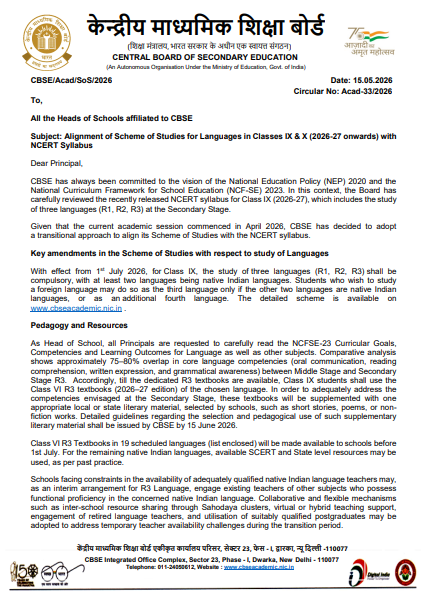
Earlier, the CBSE announced that studying ‘3 languages, including at least 2 native Indian languages, would be mandatory for Class 9 students from July 1
The Central Board of Secondary Education (CBSE) on Monday issued fresh guidelines for implementing the three-language policy under the National Education Policy (NEP) 2020, clarifying that the new rules will not apply to students currently studying in Class 10.
The board also announced a one-time relaxation for students currently enrolled in Classes 7, 8 and 9. These students will not have to appear for a Class 10 board examination in the third language, even though they will be required to study it.
Pragya Singh, Academic Director of CBSE, said students studying in Class 9 during the 2026-27 academic session have been granted a one-time exemption.
“These students may continue studying two foreign (non-Indian) languages but must add one Indian language as the third language. This third language will be assessed internally by the school and will not be part of the Class 10 board examination,” she said.
Third language board exam mandatory for future batches
The CBSE said the revised three-language policy will become fully applicable to students entering Class 6 from the 2026-27 academic session onwards.
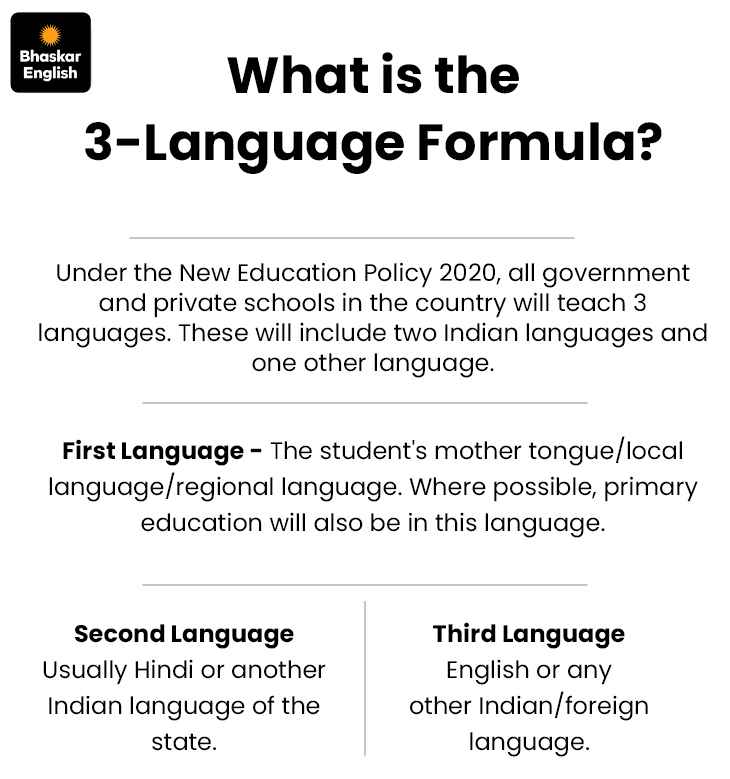
Under the policy, students must study three languages, including at least two Indian languages. When this batch reaches Class 10, the third language will also be included in the board examination.
Earlier, the board had clarified that a foreign language could be chosen only if students studied two Indian languages, or alternatively, as an additional fourth language. The latest guidelines retain this provision for future batches.
Students changing states get flexibility
The board has also allowed students who move to another state during their schooling to continue studying their existing third language (R3) until Class 9.
Meanwhile, CBSE has exempted students studying in schools abroad and foreign nationals returning to India from the requirement of studying an Indian language as the third language.
Students with disabilities will continue to receive exemptions and accommodations in accordance with existing rules.
Schools allowed multiple teaching options
To support implementation of the policy, CBSE has asked schools to use existing teachers, retired teachers, Sahodaya school clusters and hybrid teaching methods wherever required.
The board, along with NCERT, will provide textbooks and learning material for the third language. According to CBSE, Class 6 textbooks are already available in 22 scheduled Indian languages.
Changes announced earlier under NEP
The latest guidelines follow CBSE’s announcement in April to implement the three-language formula for Class 6 students in a phased manner from the 2026-27 academic session.
At the same time, the board also introduced a two-tier system for Mathematics and Science from Class 9. All students will write the same 80-mark examination, while those seeking higher proficiency can opt for an additional advanced paper. The first Class 10 board examination under the revised system will be conducted in 2028.
NEP 2020: India’s biggest education reform in over three decades
The National Education Policy (NEP) 2020 was approved by the Union Cabinet on July 29, 2020, replacing the previous education policy introduced in 1986 and revised in 1992.
The policy aims to modernise India’s education system by promoting multidisciplinary learning, skill development and greater flexibility in curriculum. The Centre has set 2030 as the target year for its implementation.
Since education falls under the Concurrent List of the Constitution, implementation of the NEP requires cooperation between the Centre and the states, and adoption of its provisions may vary across states.