
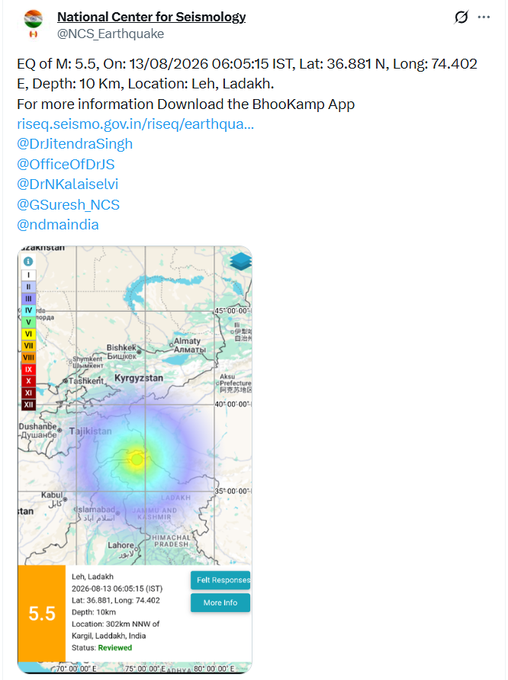
An earthquake of magnitude 5.5 on the Richter scale struck Leh, Ladakh, at 6:05 am on Thursday, the National Centre for Seismology reported.
The depth of the earthquake was reported at around 10 kms.
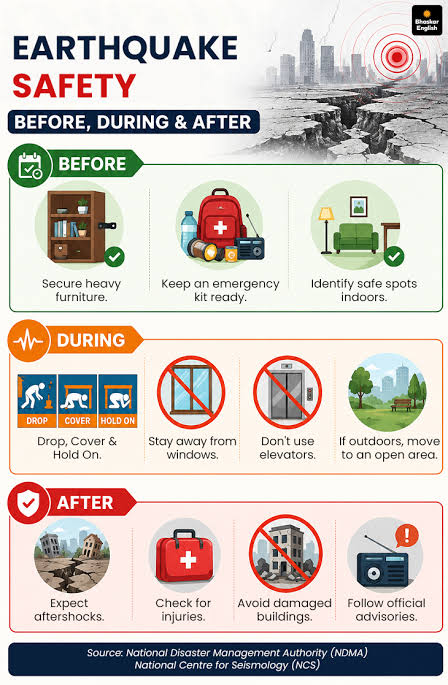
What to do during an earthquake?
An earthquake is the sudden shaking or trembling of the Earth’s surface caused by the rapid release of energy stored beneath the crust.
This energy is released when large sections of the Earth’s outer layer, called tectonic plates, shift, collide, slide past, or pull away from each other along fractures known as fault lines. The released energy travels in the form of seismic waves, which cause the ground to shake.
The Earth’s crust is divided into several large tectonic plates that are constantly moving, although extremely slowly (a few centimetres per year). Earthquakes usually occur at the boundaries of these plates where stress builds up over time until it is suddenly released.
Why is India highly vulnerable?
India lies on one of the most active seismic regions in the world due to the ongoing collision between the Indian and Eurasian plates.
This continuous collision is responsible for the formation of the Himalayas, but it also creates immense geological stress. The pressure does not get released smoothly, so it accumulates and is periodically released as earthquakes of varying magnitudes.
Additional reasons for India’s high vulnerability include:
Presence of multiple active fault zones (Himalayan seismic belt, Indo-Burma range, Kutch region)
Dense population in high-risk zones
Rapid urban expansion with uneven enforcement of seismic safety norms
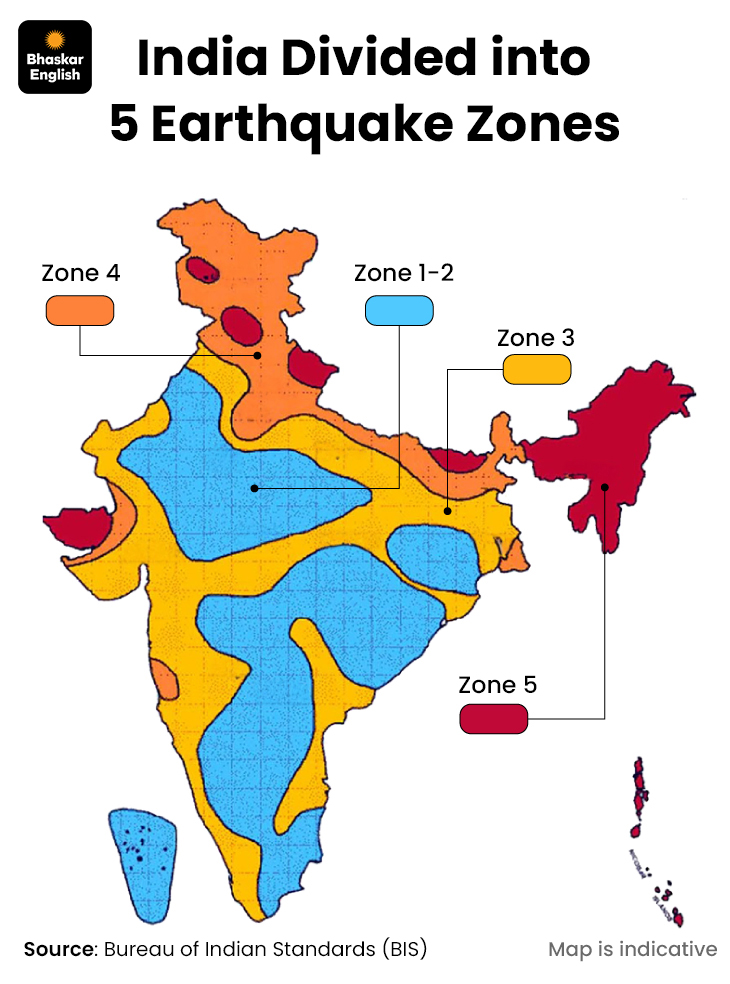
India is scientifically divided into five seismic zones based on earthquake risk:
Zone I – Very low risk (no longer prominently used in updated BIS mapping)
Zone II – Low risk
Zone III – Moderate risk
Zone IV – High risk
Zone V – Very high risk (most earthquake-prone areas)
Previous earthquakes in India
Tremors of a 6.2-magnitude earthquake in Afghanistan on June 27 were felt in Delhi, Jammu & Kashmir and other northern states. Although India experienced the impact.
| Date | Location | Magnitude | Details |
| August 9 | Nashik, Maharashtra | 4.3 | Tremors were felt in Nashik and cracks were reported in some houses. No casualties were reported. |
| July 30 | Nashik, Maharashtra | 3.8 | The quake occurred at 2:37 am at a depth of 5 km, according to the National Centre for Seismology (NCS). |
| July 24 | Nashik, Maharashtra | 3.7 | A 3.7-magnitude quake struck Nashik at a depth of 5 km, according to the NCS. |
| April 12 | Doda, Jammu & Kashmir | 4.6 | The earthquake struck at around 4:32 am at a shallow depth of about 10 km. |
| March 7 | Sikar, Rajasthan | 3.5 | Mild tremors were felt in Sikar district in the morning. No immediate damage or casualties were reported. |