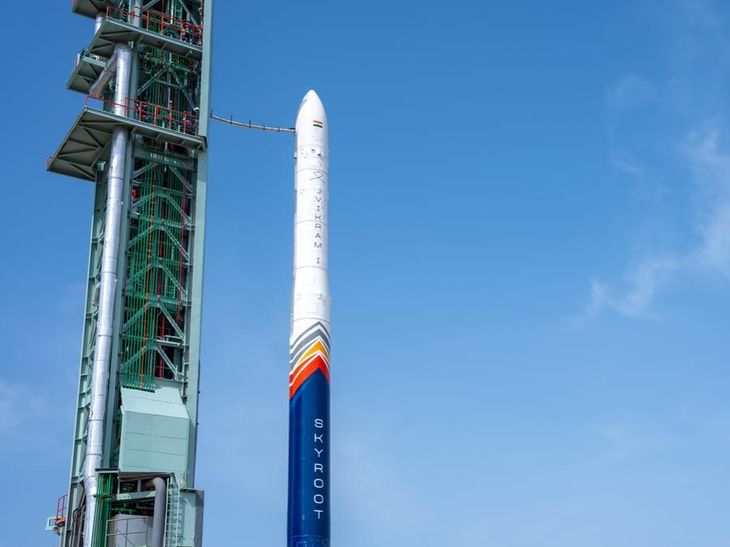

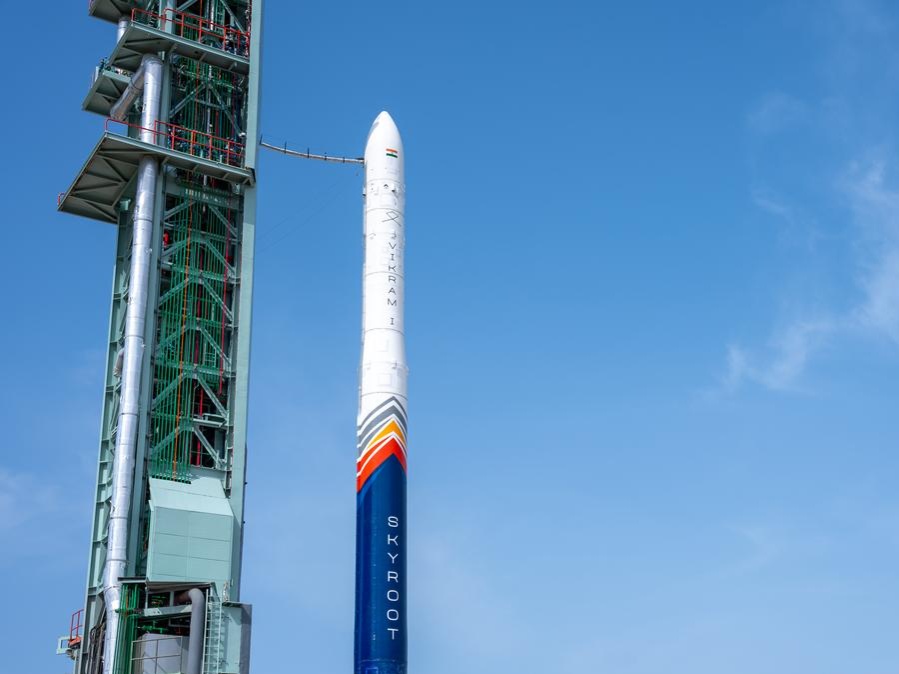
Hyderabad’s Skyroot Aerospace will launch India’s first private orbital rocket Vikram-1 today, Saturday, July 18. This launch will take place at 11:30 AM from Sriharikota in Andhra Pradesh. The company had launched the Vikram-S suborbital rocket in 2022, which reached an altitude of 89.5 km. Now Vikram-1 will send payloads to Low Earth Orbit at 450 km.
Gold Kalam, Sarabhai and CV Raman will also go
This launch has been named ‘Mission Aagaman’. Under this, the Vikram-1 rocket is carrying payloads related to technology as well as art to space:
Commercial and Technology Payloads:
- Graha Space’s technology payload.
- Cosmoserv Space’s payload.
- DCubed’s space research related payload.
- Skyroot Aerospace’s own in-house SCOPE payload.
An art piece made of 18 carat gold will also go to space
Cosmos Diamonds’ artwork “Cosmic Bloom” and a special micro-art piece are also being sent in the rocket. This micro-art piece is a small rocket made of 18 carat gold. On this, microscopic sculptures of scientist Sir C V Raman, Dr. Vikram Sarabhai and Dr. Kalam have been engraved.
The entire rocket is made of lightweight carbon-composite
Vikram-1 is the first orbital rocket made entirely from lightweight and strong carbon-composite structure. Carbon fiber is five times lighter than steel. This reduces the rocket’s weight, thereby increasing its fuel efficiency. To power the rocket, it has been equipped with three solid-fuel stages and a liquid orbital adjustment module.
1. Three Solid-Fuel Stages:
You can understand this as three extremely powerful ‘boosters’ attached at the bottom of the rocket, which are filled with solid fuel like a solid chemical similar to gunpowder.
To lift the rocket from the ground and push it towards the sky, a very heavy force is needed initially. These three solid stages burn one by one and give the rocket an initial thrust to reach near the boundary of space in Low Earth Orbit.
2. Liquid Orbital Adjustment Module
This is an extremely fine and smart liquid fuel small engine installed in the upper part of the rocket. When the rocket reaches space, solid fuel doesn’t work there because it cannot be turned on or off at will. This is where the ‘liquid module’ comes in handy.
It does the work of giving the satellite the right direction in space, increasing or decreasing the rocket’s speed, and ‘adjusting’ or establishing the satellite in its designated orbit.
Now answers to 5 important questions
Question 1: When and for what purpose was ‘Skyroot Aerospace’ started?
Answer: Skyroot was started about 8 years ago in 2018. The main purpose of starting it is to manufacture extremely affordable and reliable rockets in India itself, so that on-demand and budget-friendly launching solutions can be provided to satellite operators around the world.
Question 2: Why is this rocket named ‘Vikram-1’ and what is its significance?
Answer: This rocket has been named ‘Vikram-1’ in honor of Dr. Vikram Sarabhai, the father of the Indian space program. Dr. Sarabhai laid the strong foundation of the country’s space sector. Skyroot names all its rockets in this series in his honor. The first suborbital rocket ‘Vikram-S’ launched in 2022 was also part of this honor series.
Question 3: What benefits will this launch bring to India’s space sector?
Answer: This launch could be a game changer for India’s private space sector:
- Monopoly will end: Until now, only the government agency ‘ISRO’ used to do the work of launching satellites, but now private companies are also becoming stakeholders in this.
- Global Business: With the arrival of domestic private companies like Skyroot, foreign satellite companies will get very cheap, reliable and on-demand launching options in India.
- Economic Development: This will strengthen the country’s space economy. New startups will get a boost and large-scale investment and employment opportunities will be created in the space sector.
Question 4: Who are the founders of Skyroot and what do they say?
Answer: Skyroot Aerospace was founded jointly by Pawan Kumar Chandana (Founder and CEO) and Naga Bharath Daka (Co-Founder and COO).
CEO Pawan Kumar Chandana said that this is our first test flight and it will provide us with extremely valuable data on the rocket’s behavior in space orbit.
COO Naga Bharat Daka said that our and our entire team’s eight years of hard work is materializing today in the form of this historic milestone.
Question 5: What is the difference between ‘Vikram-S’ launched in 2022 and this new ‘Vikram-1’ rocket?
Answer: There is a major difference between these two rockets at the level of technology and capability:
- Vikram-S: This was the country’s first private suborbital rocket launched in the year 2022. It only went up to a height of 89.5 km and came back. It was not designed to orbit the Earth, only for testing purposes.
- Vikram-1: This is an ‘orbital-class’ rocket. Its job is to place satellites in Earth’s orbit. It has the capability to go up to a height of 450 kilometers and place payloads weighing approximately 350 kilograms in orbit.
Difference between Vikram S and Vikram-1
| Feature | Vikram-S (2022) | Vikram-1 (2026) |
| Mission Type | Suborbital | Orbital |
| Maximum Altitude/Orbit | 89.5 kilometers | 450 kilometers (LEO) |
| Weight Capacity (Payload) | Test payload only | Up to 350 kilograms |
| Main Structure | Single-Stage | 3 Solid Stages + Liquid Module |
| Material | General Composite | Full Carbon-Composite |
Knowledge part: What is Low Earth Orbit
This is the lowest orbit of Earth which is located at an altitude of approximately 160 to 2,000 km from the ground. Most commercial and weather-related satellites orbit in this orbit. ISS, i.e., International Space Station, is also located in this orbit at an altitude of 450 km.