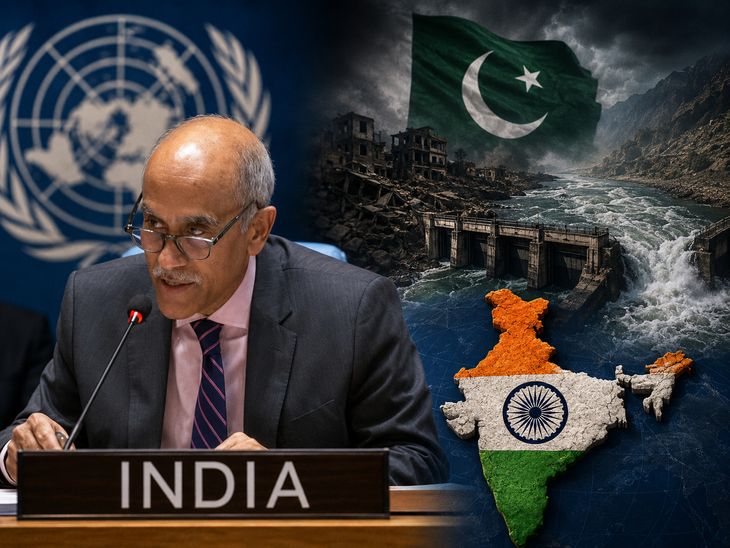

India has sharply criticised Pakistan at the United Nations Security Council (UNSC), asserting that “state-sponsored cross-border terrorism” has fundamentally undermined the basis of cooperation under the Indus Waters Treaty (IWT) and rejecting Islamabad’s attempts to raise the issue at the global forum.
Responding during the High-Level Open Debate on “Natural Resources Governance: the Foundation of Peace, Security and Prosperity” at the UNSC on Wednesday (local time), India’s Permanent Representative to the UN, Ambassador Harish Parvathaneni, accused Pakistan of misusing the platform to advance what he described as a “false narrative”.
Reaffirming India’s position on the Indus Waters Treaty, he stressed that cooperation under the agreement could not be separated from Pakistan’s continued support for terrorism.
“Our position on the Indus Water Treaty remains clear and consistent. Cooperation on the basis of mutual trust and goodwill cannot be expected when cross-border terrorism is regularly deployed as an instrument of State policy,” he said.
India reiterates stand on Jammu and Kashmir
Parvathaneni also dismissed Pakistan’s claims regarding Jammu and Kashmir, reiterating that the Union Territory “has always been, is, and will remain an integral and inalienable part of India.”
The ambassador further asserted that the only unresolved issue concerning Jammu and Kashmir was Pakistan’s “naked aggression and illegal occupation” of Indian territory.
Treaty placed in abeyance after Pahalgam terror attack
India suspended the operation of the Indus Waters Treaty following the 22 April 2025 terrorist attack in Pahalgam, Jammu and Kashmir, in which 26 people were killed.
After a meeting of the Cabinet Committee on Security (CCS) on 23 April 2025, the government announced that the treaty would remain in abeyance, arguing that the circumstances under which the agreement was negotiated had fundamentally changed.
According to government sources, the treaty can no longer function in its existing form and will remain suspended until Pakistan “credibly and irrevocably” ends its support for cross-border terrorism. They added that any future consideration of the 1960 treaty would only take place as part of a broader renegotiation process.
Sources also said Pakistan’s attempts to portray itself as a victim and mobilise international support on the issue had failed to gain traction.
India accuses Pakistan of violating treaty mechanisms
Government sources said the Indus Waters Treaty provides for a phased dispute resolution process, beginning with bilateral government-level discussions, followed by referral to a Neutral Expert, and only then, if necessary, to a Court of Arbitration.
According to officials, Pakistan violated these provisions by directly approaching the Court of Arbitration, making those proceedings non-binding on New Delhi.
Pakistan has also repeatedly objected to India’s projects on the eastern rivers, which fall within India’s rights under the treaty, while failing to develop sufficient storage and dam infrastructure within its own territory, sources said. They described Islamabad’s criticism as reflecting “double standards”.
India says Pakistan rejected proposal to update treaty
Officials revealed that India formally approached Pakistan in 2023 seeking discussions to modernise the treaty in light of changing realities, including population growth, rising developmental needs, climate change and advances in engineering and technology.
India also accused Pakistan of repeatedly internationalising technical disputes over Indian hydropower projects by simultaneously pursuing proceedings before both the Neutral Expert and the Court of Arbitration.
India to accelerate hydropower projects in Chenab basin
India plans to speed up hydropower development in the Chenab basin to maximise the utilisation of its legitimate share of Indus waters.
Priority projects include:
Sawalkote Hydroelectric Project – 1,856 MW
Pakal Dul Project – 1,000 MW
Ratle Project – 850 MW
Kiru Project – 624 MW
Kwar Project – 540 MW
India will also undertake sediment flushing and reservoir management at the Salal and Baglihar projects to restore storage capacity, improve dam safety and increase hydropower efficiency.