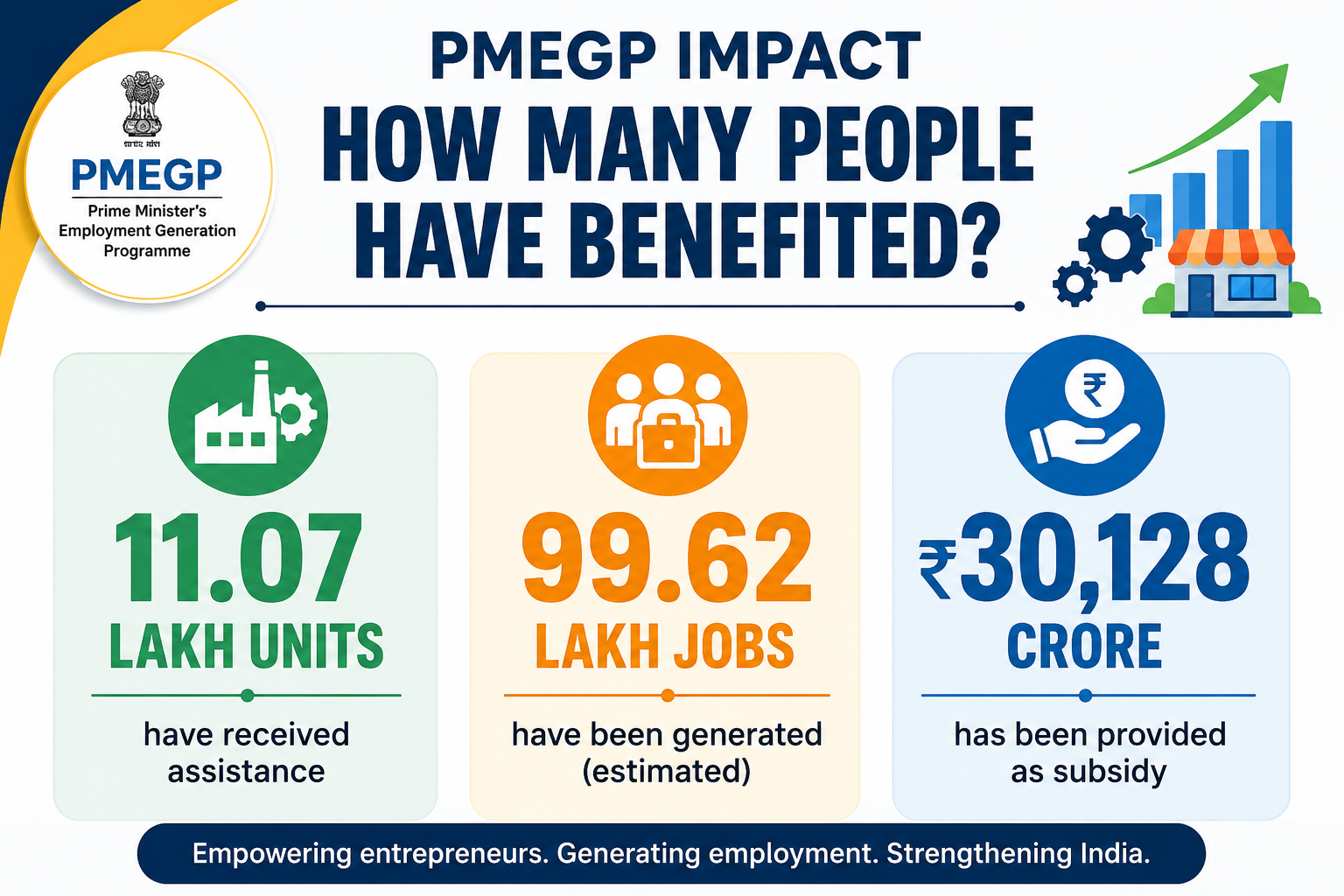


Dreaming of starting your own business but worried about the money? The government runs several schemes that can help first-time entrepreneurs get funding. One of them is the Prime Minister’s Employment Generation Programme (PMEGP), which supports people looking to set up small businesses and self-employment ventures in both rural and urban areas.
Under the scheme, you do not have to arrange the entire project cost yourself. For instance, if you plan to set up a furniture manufacturing unit in a rural area with a project cost of ₹20 lakh, you may need to contribute only ₹2 lakh.
The government can provide ₹5 lakh as subsidy, while the remaining ₹13 lakh can be arranged through a bank loan.
1. How much subsidy can you get when starting a new business?
The government provides a significant part of the project cost as a subsidy, known as margin money. The remaining amount is financed through a bank loan.
General category: You have to contribute 10% yourself. The subsidy is 25% in rural areas and 15% in urban areas.
All other categories: You have to contribute 5% yourself. The subsidy is 35% in rural areas and 25% in urban areas.
The maximum project cost is ₹50 lakh for manufacturing and ₹20 lakh for business or service activities. If the project costs more than this, the bank may provide an additional loan, but the additional amount will not qualify for a government subsidy.
All new units must be registered on the Udyam portal. Registration is free.
2. What help is available for expanding an existing business?
Successful PMEGP, REGP and MUDRA units can get a second loan. The business must be performing well and the first loan must have been repaid on time.
For the second loan:
Manufacturing: Maximum project cost of ₹1 crore, with a subsidy of up to ₹15 lakh. For the North-Eastern and hill states, the subsidy can go up to ₹20 lakh.
Business/service: Maximum project cost of ₹25 lakh, with a subsidy of up to ₹3.75 lakh. In the North-Eastern and hill states, it can go up to ₹5 lakh.
Who is eligible?
The applicant must be an Indian citizen and at least 18 years old. There is no upper age limit.
For manufacturing projects costing more than ₹10 lakh and business/service projects costing more than ₹5 lakh, the applicant must have passed at least Class 8.
Only one person from a family can benefit from the scheme. For this purpose, a family includes the applicant and their spouse.
The project must include capital expenditure. The cost of land is not included, but the cost of a ready-built shed or a workshop taken on rent or lease for up to three years can be included.
3. How do you apply and get the loan?
Applications are submitted online. Aadhaar and its verification are required. Where Aadhaar is not available, other identity documents such as PAN may be accepted.
The application must include a photograph, caste/special category certificate, rural area certificate, DPR, educational and training certificates and other required documents.
The application is checked within five working days. It is then evaluated using a scorecard. Projects up to ₹10 lakh require a minimum score of 50, while projects above ₹10 lakh require a minimum score of 60.
The application is forwarded to the bank within three weeks. The bank then conducts financial and technical assessments and takes a decision to approve or reject the loan within 30 days.
For loans of up to ₹10 lakh, the bank cannot ask for collateral security.

4, Is EDP training compulsory?
Yes. Entrepreneurship Development Programme (EDP) training is required before the loan is released.
For projects up to ₹5 lakh, five days of training is required, while projects above ₹5 lakh require 10 days of training.
Training is not compulsory for projects up to ₹2 lakh. Applicants who have already completed 10 days of government-sponsored training may also be exempt.
A free two-day online training programme is also available.
5. When is the subsidy provided?
After the first instalment of the loan is released, the bank claims the subsidy. The amount is kept in a reserve fund for three years.
During this period, no interest is charged on the subsidy amount or the corresponding portion of the loan.
After two years, the unit is physically verified and geo-tagged. If everything is found to be in order, the subsidy is adjusted against the loan after three years.
If the loan defaults before three years, the subsidy is returned.