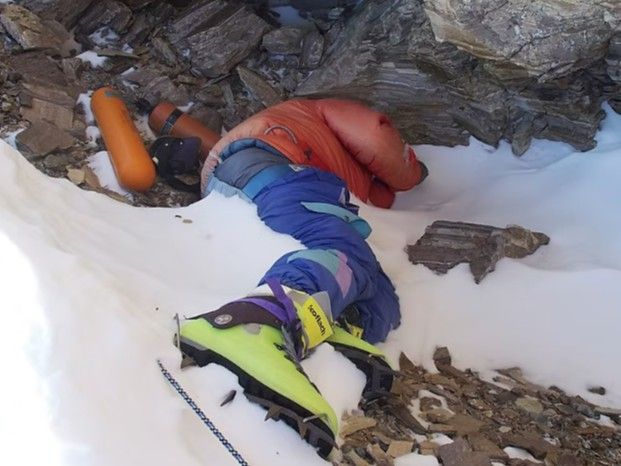

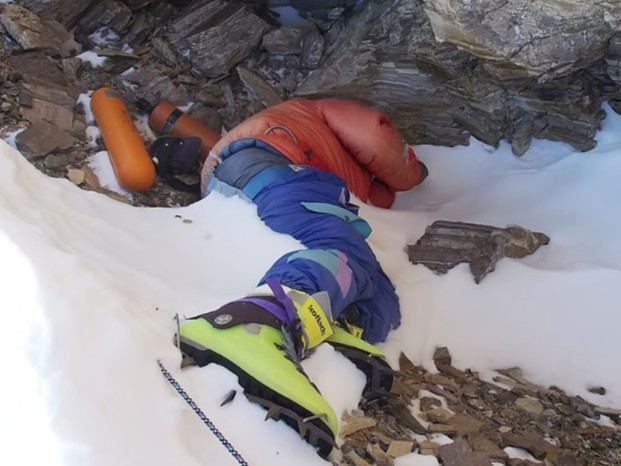
In 1996, British mountaineer and filmmaker Matt Dickinson recorded the first video of the body.
On the icy peaks of Mount Everest, at 26,247 feet in the ‘Death Zone’, a mountaineer’s body has been frozen in ice for the past 30 years. Due to the green boots on his feet, the world has known him by the name ‘Green Boots’.
For years, it was believed to be the body of ITBP Head Constable Tsewang Paljor, but recent DNA tests have confirmed that it is the mortal remains of Lance Naik Dorje Morup. Now, after 30 years of waiting, Dorje’s family in Ladakh will be handed over his body by October this year.
Dorje Morup, Tsewang Paljor, and Subedar Tsewang Smanla were part of the first Indian three-member team that set out to conquer Everest via the northern route from Tibet in 1996. On May 10, 1996, all three got caught in a severe snowstorm near the summit. This expedition later became known as the ‘1996 Mount Everest Disaster’, in which 12 mountaineers died that season.
75-year-old wife says – I will take my last breath only after seeing him
Bhaskar reached Dorje’s house and met his wife Konchok Yangskyt. 75-year-old Konchok can no longer hear. She survives on her husband’s pension. Ever since her son Phuntsog Dorje informed her about the mission to bring back his father’s body, she has been crying.
She has written on paper and given it to her son that her last wish is to see her husband once. She wrote, “I will take my last breath only after seeing him.” Dorje’s son Phuntsog is in the Indian Army. He said that ITBP has not given him complete information about the mission yet. Mother has spent her entire life crying while waiting for father. Now hope is visible in her eyes.
Green Boots became a landmark for Everest climbers
In 1996, British mountaineer and filmmaker Matt Dickinson first recorded a video of Dorje Morup’s body trapped in the snow. Later, this footage also appeared in the ‘Summit Fever’ documentary. Due to the green-colored boots on his feet, this body was given the name ‘Green Boots’.
This body lay in a small cave on Everest’s northern route which became famous as the ‘Green Boots Cave’. Almost all mountaineers heading to the summit passed through this route. For them, it became a landmark on the path.
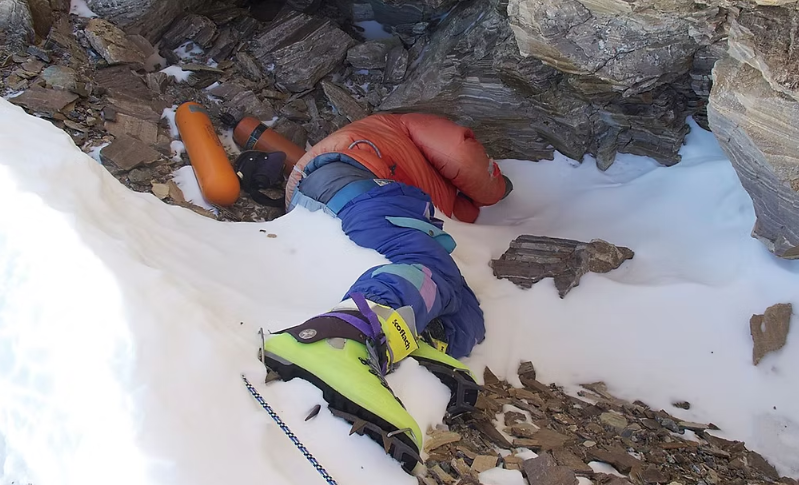
Dorje Morup’s body was lying in a small rocky cave on Everest.
Why the body could not be retrieved for 30 years
The place where Dorje’s body lies is the ‘Death Zone’ above 8 thousand meters (approximately 26,247 feet). Here there is only about 33% oxygen compared to sea level. At such high altitude, the body starts giving up rapidly. Cells begin to die.
Helicopters cannot reach here either. That’s why bringing back bodies from here is considered one of the most difficult missions in the world. This is the reason why most of the bodies of more than 340 mountaineers who died on Everest are still lying there.