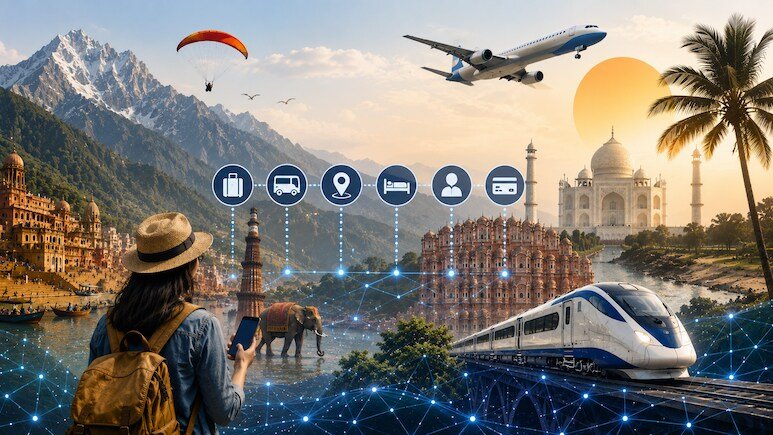

India has taken another step towards building a more connected digital tourism ecosystem with the launch of the National Digital Tourism Stack. The initiative has been launched by the Ministry of Tourism in collaboration with the Open Network for Digital Commerce, or ONDC. The project aims to create digital public infrastructure that can bring different tourism services and experiences together through a shared digital ecosystem. The initiative was announced around World Tourism Day and is expected to focus on making tourism products more discoverable and accessible to travellers.
What is the National Digital Tourism Stack?
India’s tourism industry includes a large number of businesses and service providers, from hotels and homestays to tour operators, local experiences, transport providers and destination-based activities.
These services often operate through different platforms and systems. The National Digital Tourism Stack is intended to provide a common digital infrastructure that can help connect these parts of the tourism ecosystem.
Instead of creating another standalone travel booking platform, the initiative is being developed as digital public infrastructure. Its broader objective is to make tourism offerings easier to discover while creating greater digital connectivity between travellers and service providers. The Ministry of Tourism and ONDC are working together on the initiative, which is expected to be developed in phases.
Why digital tourism matters for India
Tourism in India is spread across hundreds of destinations and thousands of small and large businesses. While major cities and popular tourist locations already have strong online visibility, smaller destinations and local tourism businesses can face difficulties reaching travellers. Digital platforms can help change that by making local experiences, accommodation options and tourism services easier to find.
The National Digital Tourism Stack is expected to support this broader objective by bringing tourism-related information and services into a connected digital environment. The initiative could be particularly relevant for homestays, local tour operators and small tourism businesses that may not have the resources to build large digital platforms of their own.
According to reports around the launch, the government is targeting a large number of tourism experiences and homestays as the digital tourism ecosystem expands. A pilot is expected to be developed before wider scaling.
Focus on local experiences
One of the major ideas behind the digital tourism initiative is improving the visibility of local experiences.
India’s tourism market has traditionally been strongly associated with destinations such as Goa, Kerala, Rajasthan, Delhi, Mumbai and major pilgrimage centres. However, the country also has thousands of smaller cultural, natural and community-based tourism experiences.
A digital network could make it easier for travellers to discover these destinations while giving local businesses another route to reach potential customers. This could also support the growth of domestic tourism, particularly as Indian travellers increasingly use smartphones to research destinations, compare services and make bookings.
What travellers can expect
The National Digital Tourism Stack is still at an early stage, so travellers should not expect an immediate change to every existing booking or travel service. The initiative is being developed as a wider digital infrastructure project rather than a sudden replacement of existing travel platforms.
Over time, the system could help create a more connected tourism marketplace where different providers can make their services visible through participating digital networks. For travellers, the potential benefit is easier discovery. For businesses, the potential benefit is improved digital reach.
A new phase for India tourism
India’s tourism industry is increasingly moving beyond traditional travel promotion. Digital discovery, online bookings, local experiences and technology-enabled travel planning are becoming
important parts of the sector. The National Digital Tourism Stack reflects that changing environment.
Its success will ultimately depend on how widely tourism businesses participate, how effectively different digital systems connect and how easily travellers can use the services.
For now, the launch marks a new development in India’s digital tourism strategy. With ONDC involved in the project, the initiative also connects the tourism sector with the country’s wider experiment in open digital commerce infrastructure. As implementation progresses, smaller destinations and local tourism providers will be among the areas to watch closely.