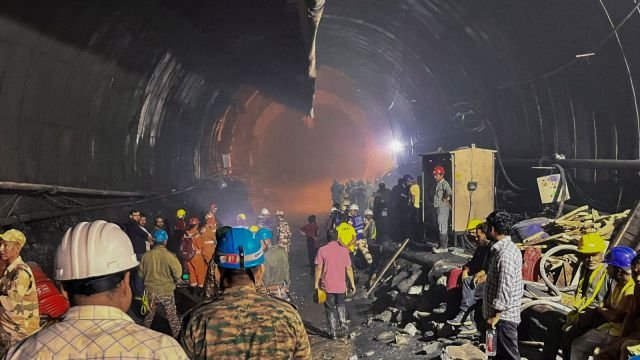

Chamoli: Seven workers lost their lives after a sudden rush of water and debris entered an under-construction hydropower tunnel at the Vishnugad-Pipalkoti project in Uttarakhand’s Chamoli district.The incident once again places the spotlight on the enormous risks faced by workers building infrastructure in India’s fragile Himalayan terrain.The accident occurred after a landslide created conditions that allowed water and debris to enter the tunnel. Rescue teams were immediately deployed as workers remained trapped underground. At least 22 people had initially been inside the affected section; several were rescued, while others were reported missing during the operation.The tragedy is particularly painful because it is not an isolated warning.
Uttarakhand has witnessed several major tunnel and landslide incidents in recent years. In 2023, 41 workers were trapped for 17 days after a tunnel collapse in the state. That rescue operation became a national story and demonstrated both the dangers of Himalayan construction and the extraordinary efforts required to save workers underground.The latest incident raises uncomfortable questions about safety standards.India is undergoing one of the largest infrastructure expansion programmes in its history. Roads, railways, tunnels and hydropower projects are being developed at extraordinary speed.But the Himalayas present unique engineering challenges.The geology is unstable. Rainfall can be extreme.
Landslides can occur suddenly. Underground water systems are difficult to predict. Seismic activity adds another layer of risk.Construction workers are often the people closest to these hazards.For families of workers killed in such accidents, the loss is not an abstract infrastructure statistic. It is the loss of a father, son, brother or husband.That human dimension must remain at the centre of India’s infrastructure debate.Development is necessary. Himalayan states need better connectivity, electricity and employment.
But speed cannot become more important than safety.Authorities must examine whether geological surveys were sufficiently detailed, whether water ingress risks were properly assessed and whether emergency evacuation systems were adequate.The tragedy should also strengthen requirements for real-time monitoring inside major tunnels.Modern tunnel construction can use sensors, geological mapping, water-pressure monitoring and automated warning systems.
These technologies cannot eliminate risk, but they can potentially provide workers and engineers with valuable minutes before a dangerous situation becomes catastrophic.Those minutes can mean the difference between life and death.The Uttarakhand tragedy is therefore more than an accident at a construction site.It is a reminder that every kilometre of tunnel, every bridge and every mountain road carries a human cost when safety is compromised.India’s infrastructure ambitions are enormous.So must be its commitment to protecting the people building that infrastructure.