
13 hours agoAuthor: Samira Siddiqui
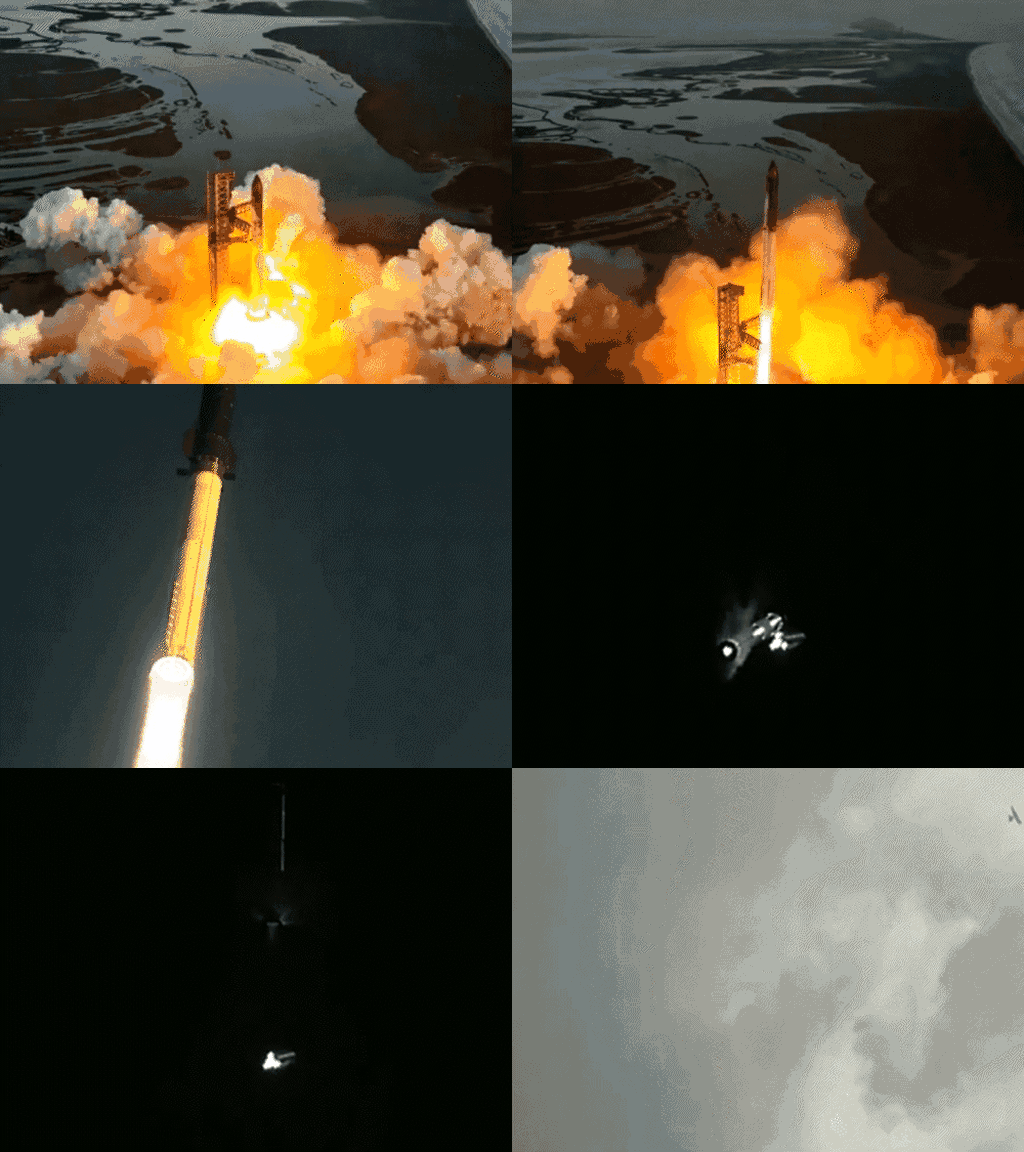
SpaceX has successfully launched Starship Flight 13, marking another major step toward building a fully reusable rocket for future Moon and Mars missions. The launch came after an earlier attempt last week was called off when several of the Super Heavy booster’s engines failed to ignite. Engineers replaced and inspected the affected engines before trying again.
A successful launch after an earlier setback
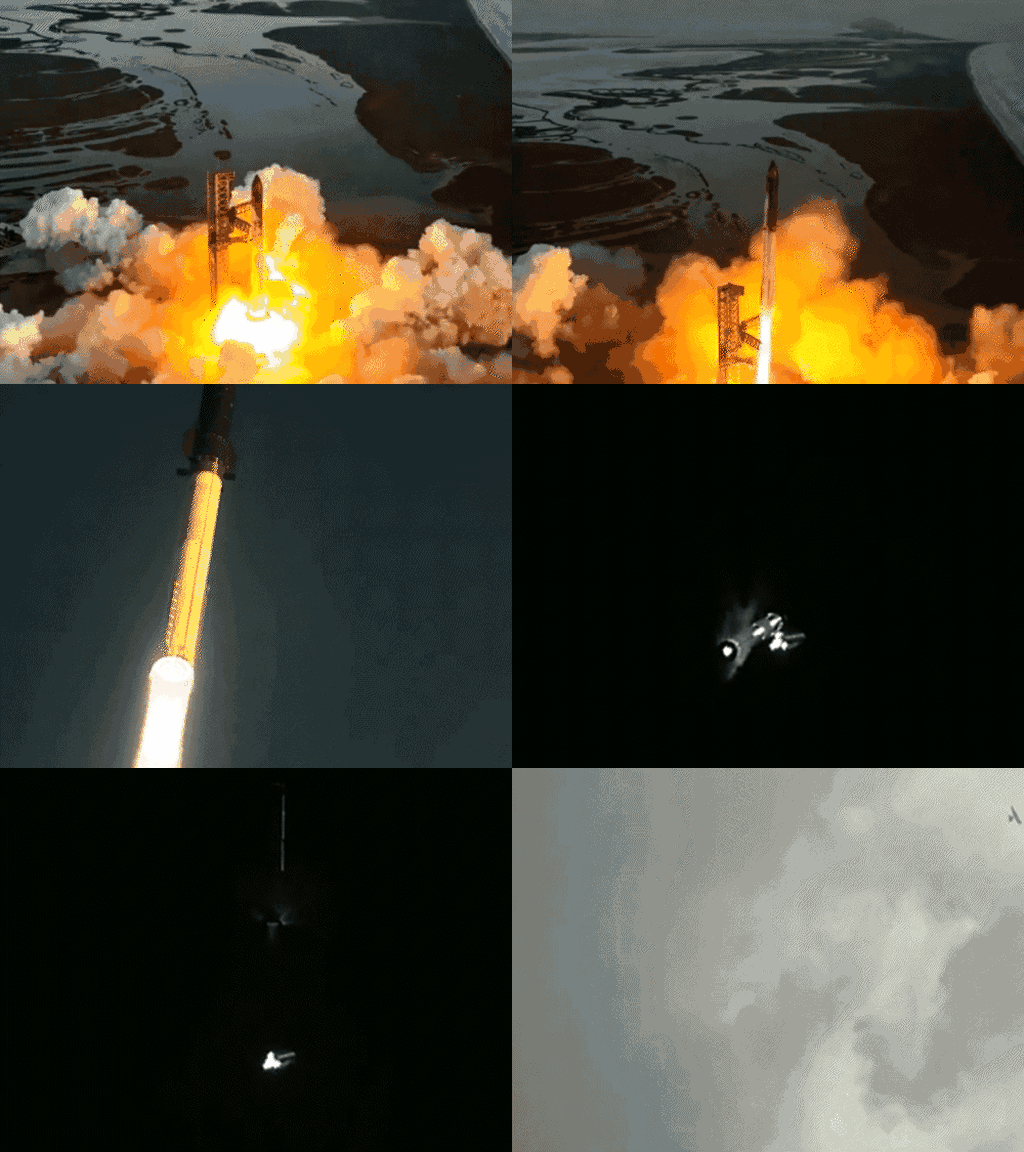
Starship lifted off from Starbase, Texas, on Friday and completed most of its planned objectives during the roughly hour-long test flight. This was the 13th integrated flight test of the Starship system and the second mission using the upgraded Version 3 (V3) vehicle, which first flew in May. Reason for rescheduling The mission has faced multiple delays over the past week: 1. July 17: The initial launch attempt was aborted at T-0 due to an automated engine ignition failure where 4 Raptor engines failed to fire correctly. 2. July 24: After SpaceX swapped out the engines and rolled the rocket back to the pad, bad weather forced another 24-hour delay.
Unlike the previous V3 test, which suffered multiple engine problems, Flight 13 showed significant improvements in performance and reliability. Starship seen floating safely in water for the first time
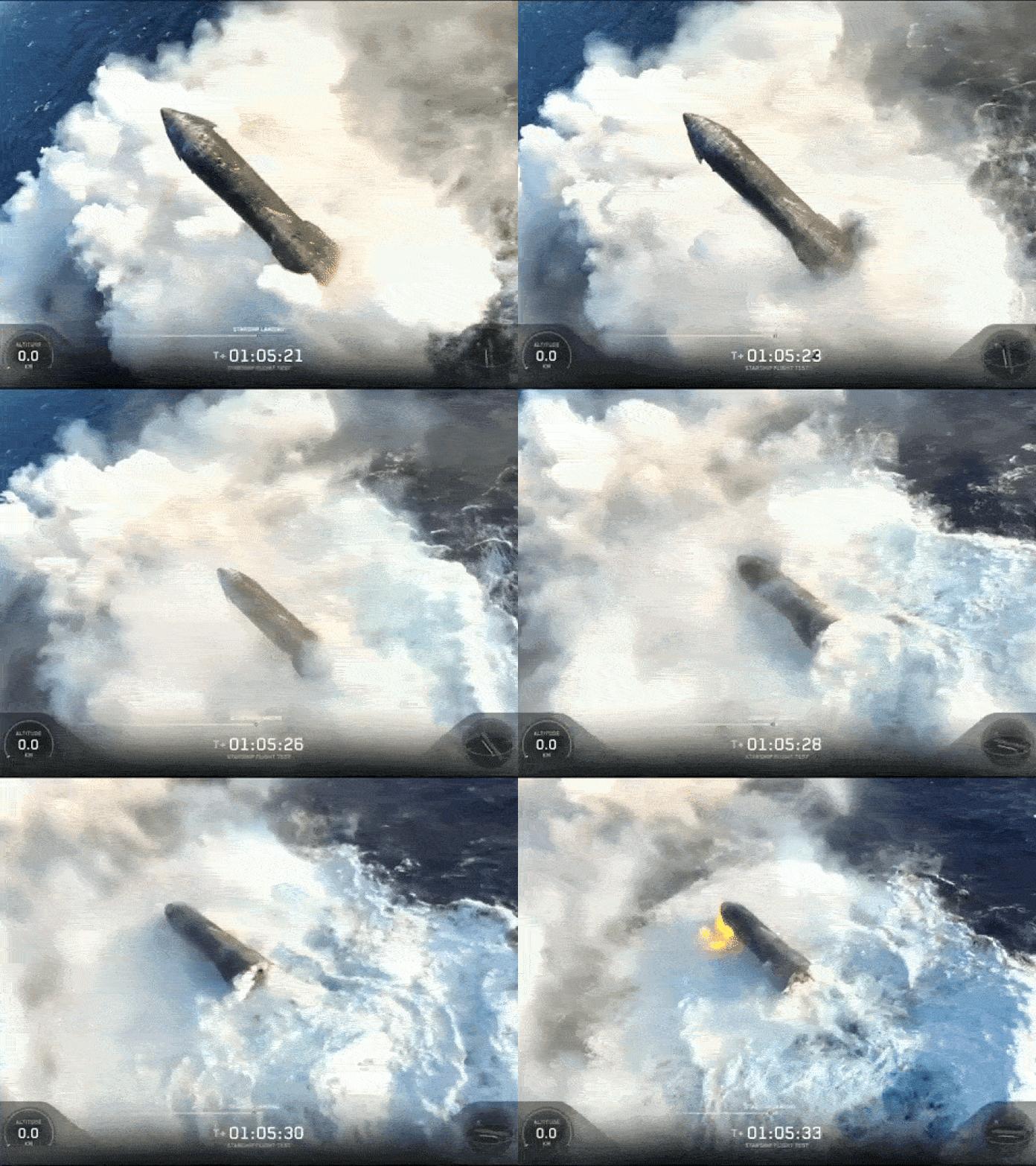
SpaceX spokesman Dan Huot said during the live stream:

This is the first time we’ve safely landed an entire Starship in water.
During the landing, Starship straightened from its belly-flop position and landed vertically on the water. It then slowly tilted to one side and began floating in the ocean.
20 Starlink satellites deployed successfully
One of the biggest achievements of Flight 13 was the successful deployment of 20 next-generation Starlink V3 test satellites.
SpaceX later confirmed that it established communication with all 20 satellites, showing that the deployment worked as expected. However, these satellites were not meant to remain in orbit. Since they were part of a test mission, they stayed in space for only a short time before burning up in Earth’s atmosphere about 20 minutes after deployment.
Also read: Instagram bans harassing videos shot using Meta smart glasses:How these AI glasses reveal personal information about strangers First deployment of real Starlink V3 satellites
In this mission, Starship deployed 20 of the newer version of Starlink V3 satellites into space for the first time. SpaceX confirmed that it had established contact with all 20 test satellites. These satellites were on a suborbital trajectory and were not designed to remain permanently in space. They burned up in Earth’s atmosphere about 20 minutes after deployment.
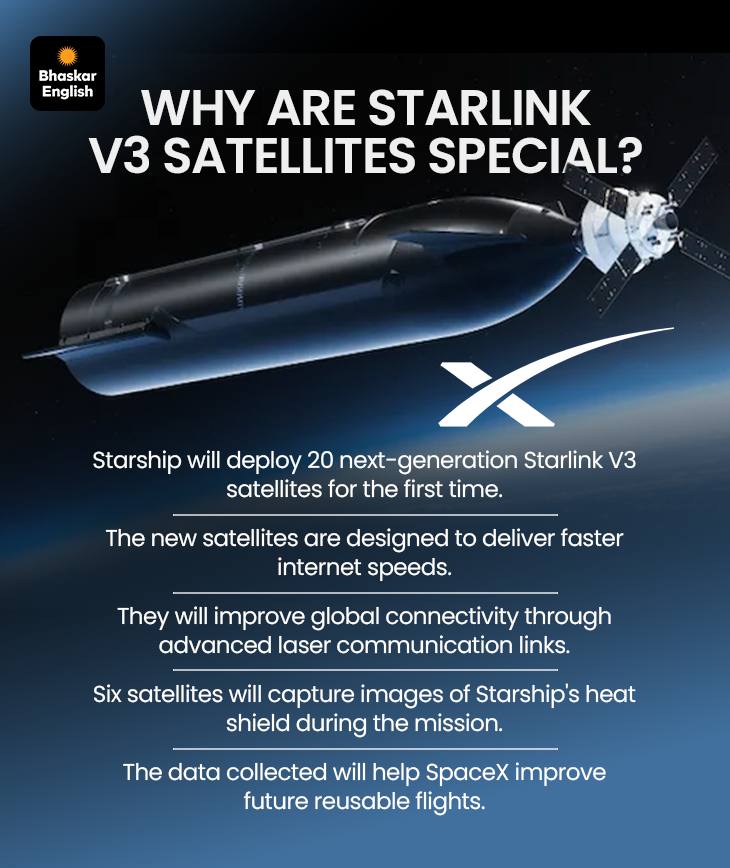
- Special changes: Six satellites were equipped with cameras that scanned Starship’s heat shield and sent images.
- Laser Test: The satellites opened their solar panels and antennas and tested connecting to the existing Starlink network via laser technology.
- Pez Dispenser: These thin and flat satellites were ejected from a narrow slit (a structure similar to a Pez dispenser) in the side of Starship.
Super Heavy boosters and improvements to ‘hot staging’
All 33 Raptor engines on the Super Heavy booster fired at launch, generating 18 million pounds of thrust. “It’s like the world’s largest machine gun firing 11 pickup trucks every second instead of bullets,” said Justin Steyer, SpaceX’s senior director of Starship launches.
Starship separated from the booster via hot staging after main engine cutoff (MECO) two minutes into flight. The previous flight in May had caused the booster to roll upside down due to all six engines not firing simultaneously, a problem that was rectified this time.
After separation, the booster performed a boostback burn using all 13 engines. While landing at a slightly higher speed and all 13 engines failed to fire, it still made a controlled landing in the Gulf. What is Starship?
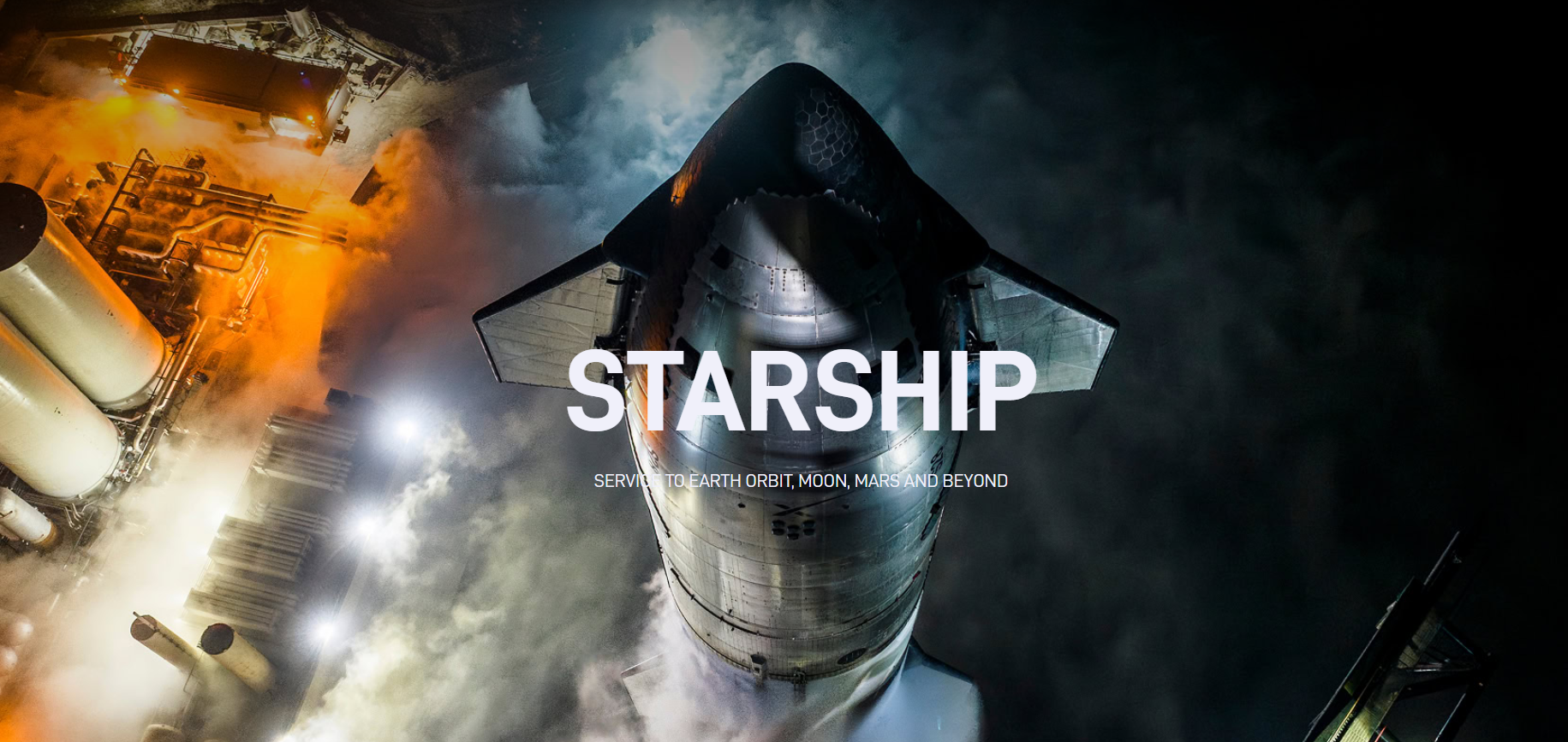
SpaceX’s goal of making Starship a fully reusable spacecraft capable of launching satellites is now successful. Image credit: SpaceX
Starship is SpaceX’s fully reusable launch system made up of two stages:
- Super Heavy Booster – the lower stage that lifts the rocket off the ground using 33 Raptor engines.
- Starship spacecraft – the upper stage that carries satellites, cargo, and, eventually, astronauts.
Together, the vehicle is capable of carrying more payload than any rocket ever built. Its biggest advantage is that both stages are designed to be reusable, which could dramatically reduce the cost of future space missions.
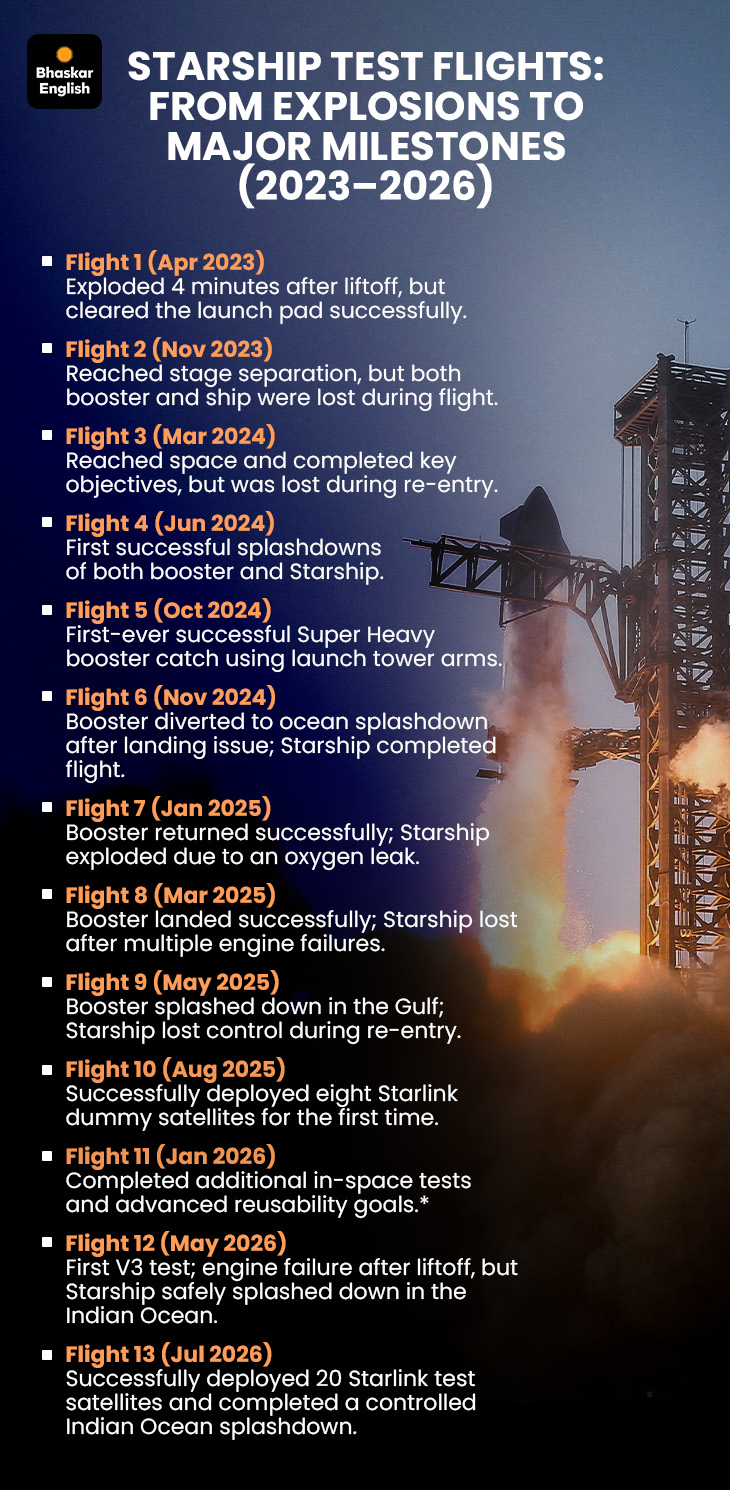
Now know about the first 11 tests of Starship through the infographic below………
Also read: Astronaut Shubhanshu Shukla reveals how Indian food reached space:Why only three dishes, including gajar ka halwa, reached the ISS How is Flight 13 different from previous launches?
Unlike earlier missions, Flight 13 is not just another test flight. It introduces several firsts:
1. First Starlink V3 satellite deployment
This will be the first time Starship carries 20 Starlink Version 3 satellites, which are larger, more powerful, and capable of delivering faster internet speeds than earlier versions.
2. Testing Starship as an operational launcher
Previous flights mainly focused on testing the rocket itself.
Flight 13 also evaluates Starship’s ability to deploy real payloads into space.
3. Heat shield inspection
Six satellites onboard will photograph Starship’s heat shield after deployment.
The images will help engineers study how the protective tiles perform during flight and prepare for future re-entry missions.
4. Improved systems
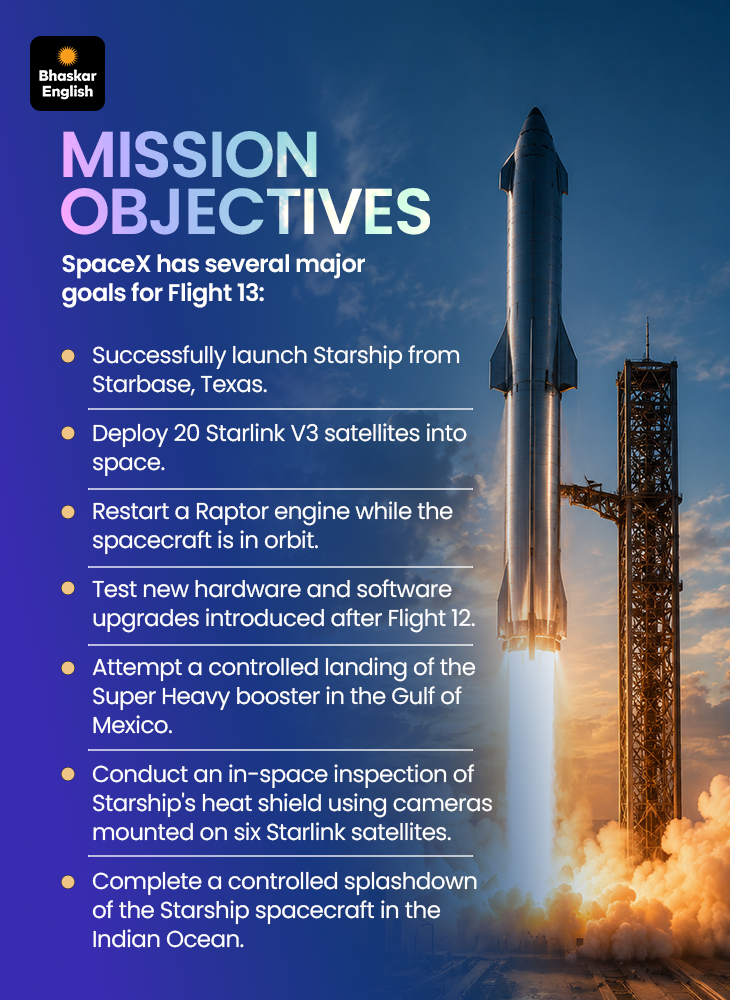
Following issues encountered during Flight 12, SpaceX has updated both software and hardware to improve engine performance and flight stability.
SpaceX continues to refine the Super Heavy booster’s landing performance, but the success of the upper-stage spacecraft brings SpaceX closer to developing a fully reusable launch system. Starship is expected to play a key role in NASA’s future Artemis Moon missions as well as SpaceX’s long-term goal of sending humans to Mars.