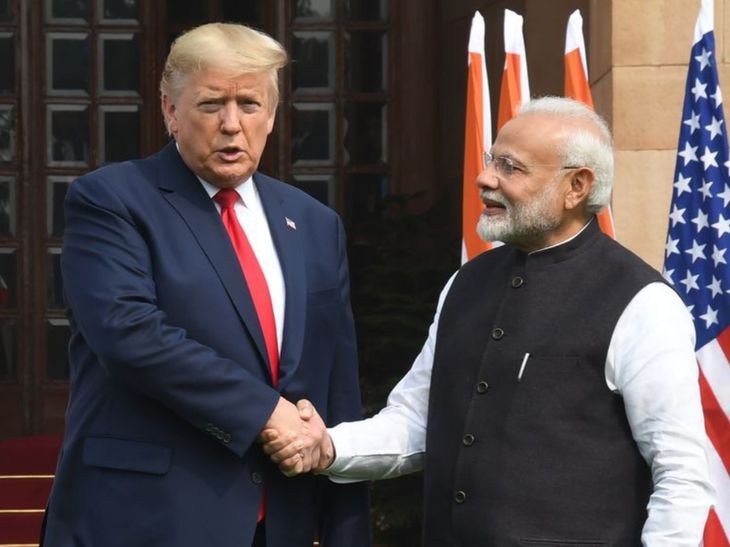

US President Donald Trump’s senior adviser Peter Navarro said on Tuesday that Trump and Prime Minister Narendra Modi have a “very good working relationship” and that the two leaders would work out the issue of a possible 100% tariff linked to Russian oil purchases.
The US Senate recently passed a bill by 86-11 votes that could allow tariffs of up to 100% on goods from countries that continue to buy significant amounts of Russian energy, including India.
The bill has not yet become law and will now go to the House of Representatives for consideration.
500% tariff was proposed
On July 23, a proposal was made to impose tariffs of up to 100% on countries buying oil and gas from Russia. However, the initial version of the bill proposed tariffs of up to 500%, which was later reduced to 100%.
Sanctions on companies trading with Iran will increase
If passed into law, the measure would extend the 1996 Iran Sanctions Act until 2031. The law places restrictions on non-US companies that do business with Iran. It was due to expire this year.
The bill would also give the US President the power to impose tariffs of up to 500% on Russian goods entering the US. This presidential authority would remain in place for five years.
The White House had previously tried to impose sanctions on Russia. However, during the Iran war, the closure of the Strait of Hormuz created an oil supply crisis. As a result, the US administration had to temporarily exempt some oil sales from the restrictions.
India bought more than half of its oil from Russia in June
In June 2026, India bought a record 2.61 million barrels of crude oil per day from Russia, accounting for 52.4% of its total oil imports. This means more than one in every two barrels of oil imported by India that month came from Russia.
Russia remains India’s largest oil supplier. Compared with May, India’s oil imports from Russia rose by around 39% in June.
Impact on India if this bill becomes law
First scenario: India continues to buy oil from Russia
If India continues buying Russian oil and the US imposes a 100% tariff, Indian exports to the US could be hit directly. Indian goods could become twice as expensive in the US, prompting American buyers to look for cheaper alternatives from countries such as Bangladesh, Vietnam, Mexico and China.
This could reduce orders for Indian products including textiles, gems and jewellery, engineering goods, leather, marine products and chemicals.
Second scenario: If India buys oil from other countries instead of Russia
If pressure from US sanctions or tariffs on Russian oil increases, India may have to buy more oil from other countries. This could be more expensive and could lead to higher petrol and diesel prices in India.
US sanctions not fully effective
US sanctions and tariffs have affected the economies and businesses of several countries, but they have not always achieved their political objectives.
1. Cuba: Since 1960
The United States imposed economic sanctions on Cuba in 1960. Even after more than six decades, the sanctions have not succeeded in changing the Cuban government. Cuba told the United Nations in 2023 that the sanctions had caused losses of more than $159 billion.
2. Iraq: Since 1990
Economic sanctions were imposed on Iraq in 1990. They had a major impact on the country’s economy and the lives of ordinary people. Oil revenues and imports of essential goods were affected. United Nations reports recorded increases in hunger, disease and poverty during the sanctions.
3. Iran: Since 2012
After strict sanctions were imposed in 2012, Iran’s oil exports fell by around 1 million barrels per day. Its economy remained in recession for two consecutive years. According to the World Bank, sanctions caused Iran to lose $17.1 billion in exports, equivalent to around 4.5% of its GDP, between 2012 and 2014.
4. China: Since 2018
In 2018, the US imposed additional tariffs on around $250 billion worth of Chinese goods. In 2019, Chinese goods imported into the US fell by 16.2% to $452.2 billion, while the trade deficit between the two countries fell by 17.6%.
However, according to the US International Trade Commission, most of the cost of these tariffs was ultimately borne by US companies and consumers.
5. Russia: From 2022
After Russia invaded Ukraine, the US and other countries imposed several economic sanctions on Russia. These made it harder for Russia to raise money abroad, conduct international business and access key technologies.
In April 2022, the IMF estimated that Russia’s economy could shrink by 8.5% that year. However, Russia reduced some of the impact by continuing to sell goods, including oil, to other countries.