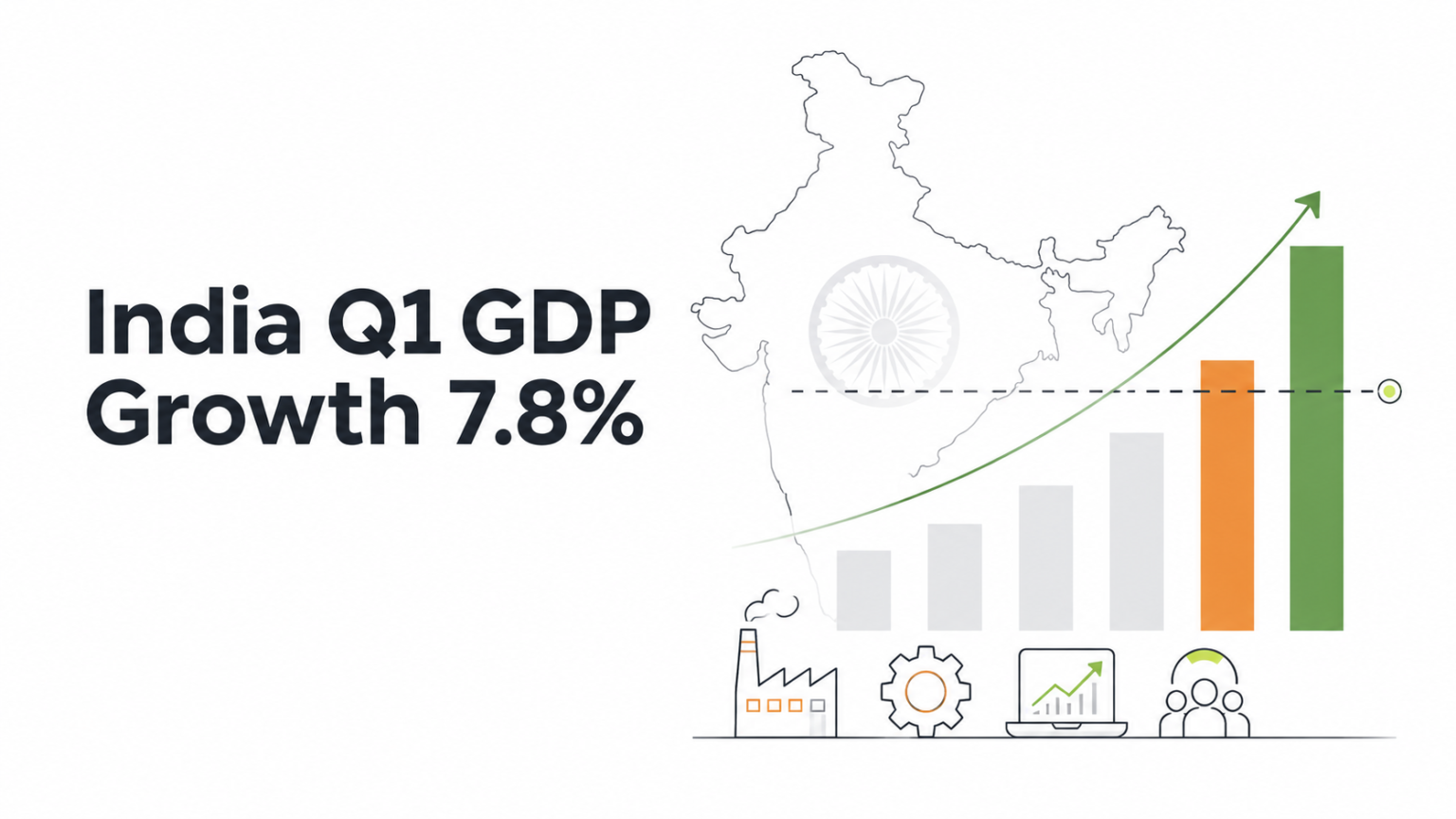

New Delhi: India’s economy has delivered a powerful signal of resilience, recording real GDP growth of 7.8% in the April-June quarter of 2026. The figure has strengthened the government’s economic narrative at a time when global markets continue to face uncertainty, geopolitical tensions and uneven demand.The latest growth number is more than a statistic on an economic dashboard. For policymakers, investors and businesses, it is an indication that the world’s fastest-growing major economies continue to possess considerable momentum despite a challenging international environment.Prime Minister Narendra Modi welcomed the figure, describing the performance as evidence of the strength of the Indian economy. His comments came as the government sought to reinforce confidence in domestic production, consumption and investment.But behind the headline number lies a more complicated economic picture.India’s manufacturing sector, for example, has recently shown signs of losing momentum.
The latest manufacturing Purchasing Managers’ Index fell to 52.8 in August, its weakest expansion in five years, as softer demand affected new orders and production growth.That contrast is significant. A strong GDP print does not automatically mean every section of the economy is equally strong.GDP growth measures the overall expansion of economic activity, while indicators such as manufacturing PMI provide a more immediate picture of business conditions. The challenge for policymakers will therefore be to ensure that headline growth translates into sustained industrial activity, employment and household income.The 7.8% figure nevertheless gives India important economic ammunition.
At a time when several major economies are dealing with weak demand and uncertainty, strong domestic growth can make India more attractive to global investors.The government has also continued to push the idea of greater domestic consumption and self-reliance. Modi has urged Indians to support Indian production and spend more within the country, linking consumer behaviour with the broader goal of strengthening the domestic economy.For ordinary Indians, however, the real question is not simply whether GDP is growing.
It is whether that growth produces better jobs, stronger wages, lower economic insecurity and greater opportunities for young people.India’s demographic advantage creates both an opportunity and a responsibility. Millions of young Indians enter the workforce every year. High growth must therefore be accompanied by sufficient employment generation, particularly in manufacturing, technology, infrastructure and services.The government now faces the task of converting economic momentum into durable economic strength.The 7.8% number is undeniably powerful. But it is also a test.India has demonstrated that it can grow rapidly despite global turbulence. The next challenge is to make that growth broad-based, employment-intensive and sustainable.For now, the message from New Delhi is clear: India’s economic engine is still running strongly.The harder question is whether that engine can maintain its speed while delivering prosperity beyond the GDP headline.