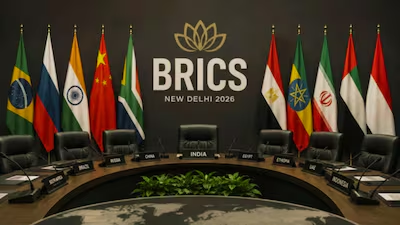

India is pushing a proposal to connect the central bank digital currencies of BRICS countries in an effort to make cross-border payments faster and easier. The proposal comes just days before the BRICS Leaders’ Summit, which is scheduled to take place in New Delhi on September 12 and 13.India is chairing BRICS this year and wants the grouping to explore new ways of improving international payments. One proposal under discussion is the possible linking of official digital currencies issued by central banks. The idea is to make it easier for businesses and financial institutions in BRICS countries to conduct cross-border transactions without depending entirely on traditional payment channels. The proposal is significant because BRICS has expanded considerably in recent years. The group now includes Brazil, Russia, India, China, South Africa, Egypt, Ethiopia, Indonesia, Iran, Saudi Arabia and the United Arab Emirates. This means that any common financial initiative would involve economies with very different financial systems, currencies and geopolitical relationships. India’s proposal builds on discussions held during the 2025 BRICS summit in Rio de Janeiro, where members supported greater interoperability between payment systems.
The broader objective is to make international trade payments more efficient. For Indian businesses involved in exports and imports, cross-border payments can involve multiple intermediaries, currency conversions and settlement processes. A more integrated digital payment system could potentially reduce transaction time and costs. Central bank digital currencies, commonly known as CBDCs, are digital forms of national currencies issued by central banks. India has already been developing its own digital rupee through the Reserve Bank of India. A possible BRICS digital currency network would not mean that the participating countries would create a single common currency. Instead, the proposal focuses on making different digital currencies work together. India has also made it clear that the initiative is not intended to replace the US dollar as the world’s dominant reserve currency. The primary objective is to make cross-border payments easier and faster. However, turning the proposal into a functioning system could be difficult. One major challenge is the limited adoption of central bank digital currencies around the world. While countries are experimenting with CBDCs, their use by consumers and businesses remains relatively small compared with traditional bank accounts and established digital payment systems. Another challenge is political trust.
BRICS includes countries that do not always have aligned foreign-policy interests. Relations between some members remain complicated, which could make the development of shared financial infrastructure difficult. The relationship between India and China is one example. India has security concerns regarding deeper financial and technological integration with Chinese companies. These concerns could make negotiations over a common payment system more complicated. The UAE and Iran also have complicated financial relations, creating another challenge for the proposed system. Currency conversion is another major issue. A digital payment network connecting several national currencies would need a reliable mechanism for determining exchange rates and managing trade imbalances. Currency-swap arrangements could potentially become necessary to support transactions between countries. The technology would also need to meet extremely high security standards.
Financial infrastructure cannot afford major interruptions. A cross-border digital currency system would have to protect users from cyberattacks, fraud, technical failures and attempts to manipulate transactions. Despite these challenges, India’s proposal could become one of the most important economic discussions at the upcoming BRICS Summit. India has already developed one of the world’s largest digital payment ecosystems through UPI. The country’s experience with instant digital payments gives it an important role in discussions about international payment connectivity. The success of UPI in India has also attracted interest from other countries. Connecting payment systems internationally could therefore become an important part of India’s broader digital diplomacy. For businesses, the potential benefits are significant. Faster international payments could make it easier for exporters and importers to receive and send money. Smaller companies could potentially benefit from lower transaction costs and quicker settlements.
However, experts will also be watching whether the BRICS countries can overcome their political differences. Previous attempts to develop shared payment infrastructure within the group have faced difficulties. Creating a fully integrated digital currency network would require long-term cooperation between central banks, financial regulators and governments. The September 12–13 summit will therefore be important not because a complete BRICS digital currency system is expected to appear immediately, but because it could establish the direction of future cooperation. India’s proposal represents a larger shift in the global financial system toward digital payments and alternative cross-border settlement mechanisms. If BRICS countries eventually succeed in linking their CBDCs, the system could provide businesses with another channel for international payments. For India, the initiative also strengthens the country’s position as a major voice in discussions about digital finance. The immediate challenge is turning the political idea into a practical financial system. For now, the BRICS digital currency proposal remains a work in progress. But with India hosting the summit this week, the issue is expected to receive significant attention from governments, banks, businesses and financial markets around the world.