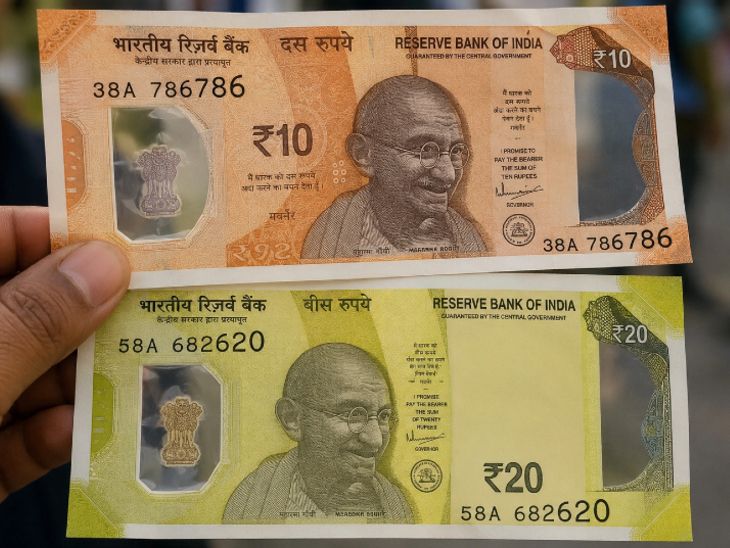

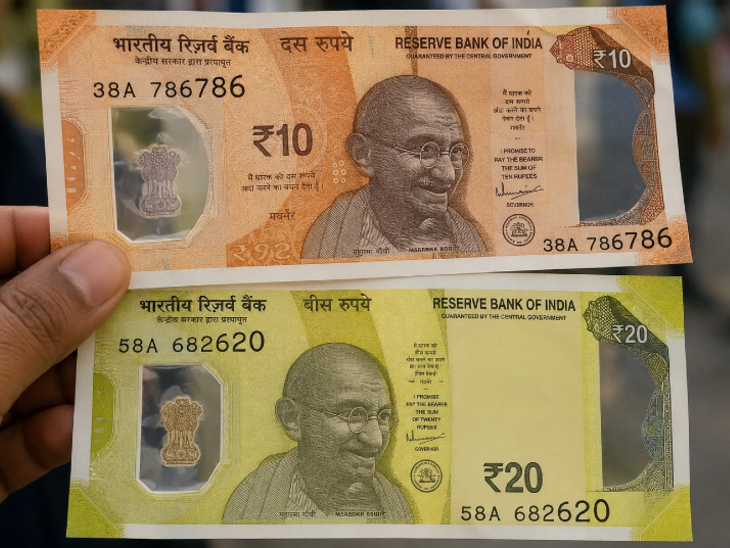
The government has approved the field trials of polymer banknotes in ₹10 and ₹20 denominations as part of a countrywide trial. In this phase, it will issue 100 crore polymer notes.
Finance Minister Nirmala Sitharaman informed the Rajya Sabha in a written reply on Tuesday. The announcement comes after the Reserve Bank of India (RBI) sent the proposal to the government under Section 25 of the RBI Act 1934 on the recommendation of its central board.
Notes will be issued regularly after successful trial
RBI had proposed a field trial of 100 crore polymer notes of ₹10 and ₹20 denominations. After the successful trial, it plans to issue the notes of these two denominations regularly.
RBI said it will issue these notes along with paper currency.
The Finance Ministry has already approved the proposal.
Sitharaman said the procurement process of polymer notes is still in progress; hence, at this stage, it is not possible to set an exact timeline of their issuance or determine the cost.
Inflation dropped to 2.1% in 2025-26: Sitharaman
Responding to another question, Sitharaman stated the average retail inflation, based on the Consumer Price Index (CPI), dropped from 5.4% in 2023-24 to 4.6% in 2024-25 and 2.1% in 2025-26.
She said inflation rose due to commodity price shocks triggered by the West Asian crisis and high international energy prices. In the first quarter of 2026-27, retail inflation rose to 3.9% due to seasonal spikes in vegetable prices and concerns over the adverse effects of El Niño.
Still, current inflationary pressure is below the RBI’s 4% inflation target.
New GST rates do not burden taxpayers: Finance Minister
Sitharaman said the two-rate GST structure introduced in the 56th meeting of the GST Council set the rates at 18%, 5%, and 40%. She stated that the 40% rate includes the previous compensation cess. Therefore, there has been no increase in the overall tax burden.
This change has reduced the rates of many goods and services from 28% to 18%, from 18% to 12% or 5%, and from 12% to 5% or zero.
Excise duty on petrol, diesel reduced by ₹10
Sitharaman said the government has made changes to the basic customs duty (BCD) on several goods to reduce input costs, boost domestic manufacturing, strengthen export competitiveness and support strategic sectors.
Additionally, BCD has been reduced for crude palm oil, crude soybean oil and crude sunflower oil to lower the prices of essential commodities. These changes, announced in the Central Budget 2026-27, came into effect on 2 February, 2026.
The Agriculture Infrastructure and Development Cess on lentils has also been reduced. Likewise, in March 2026, the central excise duty on petrol and diesel was cut by ₹10 per litre.
Tax exemption of up to ₹12 lakh annual income
Besides indirect tax reforms, the Finance Minister said the government increased people’s disposable income, with annual income of up to ₹12 lakh now tax-exempt.
For salaried people, annual income up to ₹12.75 lakh is tax-free after standard deduction.
She said that these measures have supported domestic consumption. The share of private consumption expenditure in GDP is between 56.5% and 56.7%, with 2022-23 as the base year.
According to the latest GDP estimates released by the Ministry of Statistics and Programme Implementation, per capita private final consumption expenditure increased by 6.8% in 2025-26, up from 4.8% in 2023-24.
Sitharaman said the government has been continuously monitoring the price situation in the country. Financial, administrative and supply-related measures are taken to protect people’s purchasing power, with a special focus on low- and middle-income families.