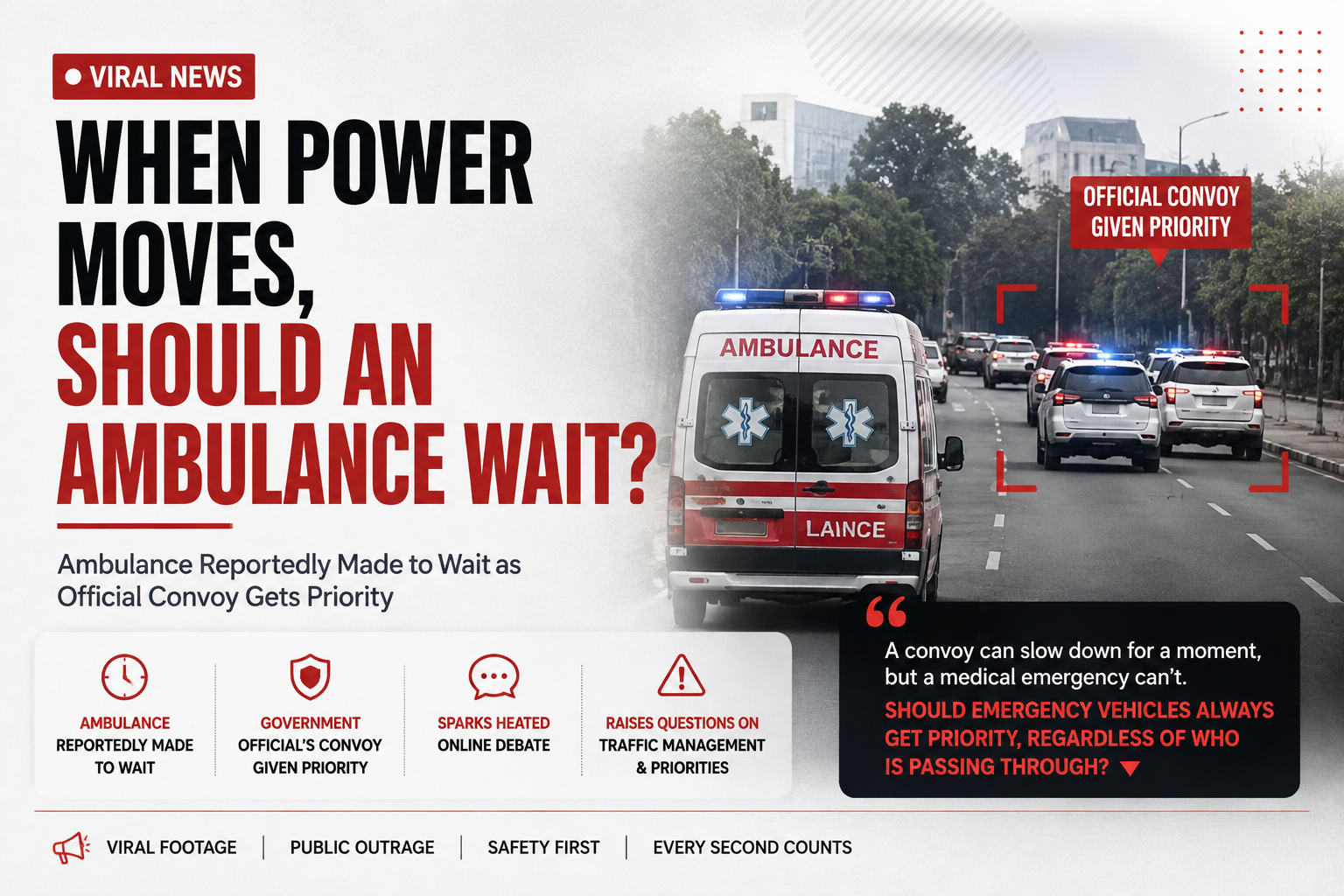

A viral video showing an ambulance reportedly being made to wait while a government official’s convoy was given priority has triggered a strong debate over traffic management, VIP movement and the priority that must be given to emergency vehicles.The footage, shared widely on social media, appears to show a busy road where traffic has been held to facilitate the movement of an official convoy. An ambulance can reportedly be seen waiting during the traffic restriction. The exact location, identity of the official and circumstances surrounding the incident have not been independently established from the footage alone. However, the video has quickly drawn public attention because it raises a much larger issue than a single traffic stoppage, how emergency vehicles should be treated when VIP movements take place.Security arrangements for government officials and other protected individuals can require temporary traffic restrictions. Police personnel may need to clear roads, manage intersections and create a safe passage for a convoy.
Such measures can be necessary, particularly when security protocols are involved.But an ambulance operates under a completely different urgency. A convoy can potentially slow down or stop for a few moments. A patient inside an ambulance may be travelling against time, where even a short delay can become critical.This is why the video has sparked anger and concern among social media users. For many people, the issue is not about targeting a particular official or questioning the need for security. The bigger concern is whether traffic systems are equipped to identify and immediately clear a path for emergency vehicles, even during high-security movements.The incident also highlights the difficult responsibility faced by traffic police on crowded roads. Officials managing a convoy may have to balance multiple priorities at the same time, including security, public movement, emergency response and road safety. In such situations, clear protocols become extremely important.Emergency vehicles should never become an afterthought in traffic planning. Ambulances, fire engines and other emergency-response vehicles carry a very different level of urgency.
Their movement can directly affect someone’s chances of receiving timely medical care.The viral footage has therefore moved beyond a simple question of who was allowed to pass first. It has opened a conversation about how cities manage roads when VIP movements and public emergencies happen at the same time.The larger expectation from citizens is straightforward, security can be protected without compromising emergency access. Better coordination between convoy security teams, traffic police and emergency services can help ensure that an ambulance is identified early and given a safe route whenever possible.At the same time, the incident should be viewed responsibly. A short viral clip may not show the complete sequence of events, and conclusions about individual responsibility should not be drawn without verification. Authorities may need to establish what happened, why the ambulance was stopped and whether established emergency-vehicle protocols were followed.
Ultimately, the debate is about more than one road, one convoy or one ambulance.It is about a principle that matters on every busy street: when someone is fighting for their life, every second counts.A convoy may have a schedule.An ambulance may have a patient who cannot wait.And on the road, that difference should matter.